Rework Loop Mapping: How to Remove Hidden Factory Costs
Manufacturing executives and operation managers often focus on visible metrics such as output, cycle time, scrap rate, labor hours, and machine uptime. Yet many factories struggle with profitability despite strong production numbers. The reason is often hidden in plain sight: rework loops.
Manufacturing executives and operation managers often focus on visible metrics such as output, cycle time, scrap rate, labor hours, and machine uptime. Yet many factories struggle with profitability despite strong production numbers. The reason is often hidden in plain sight: rework loops.
Rework is one of the most underestimated drains on operational performance. It quietly consumes labor, machine capacity, materials, and management attention. Unlike scrap, which is visible and measurable, rework appears productive on paper because parts are ultimately completed. However, beneath the surface, rework erodes margins, extends lead times, disrupts scheduling, and damages customer trust.
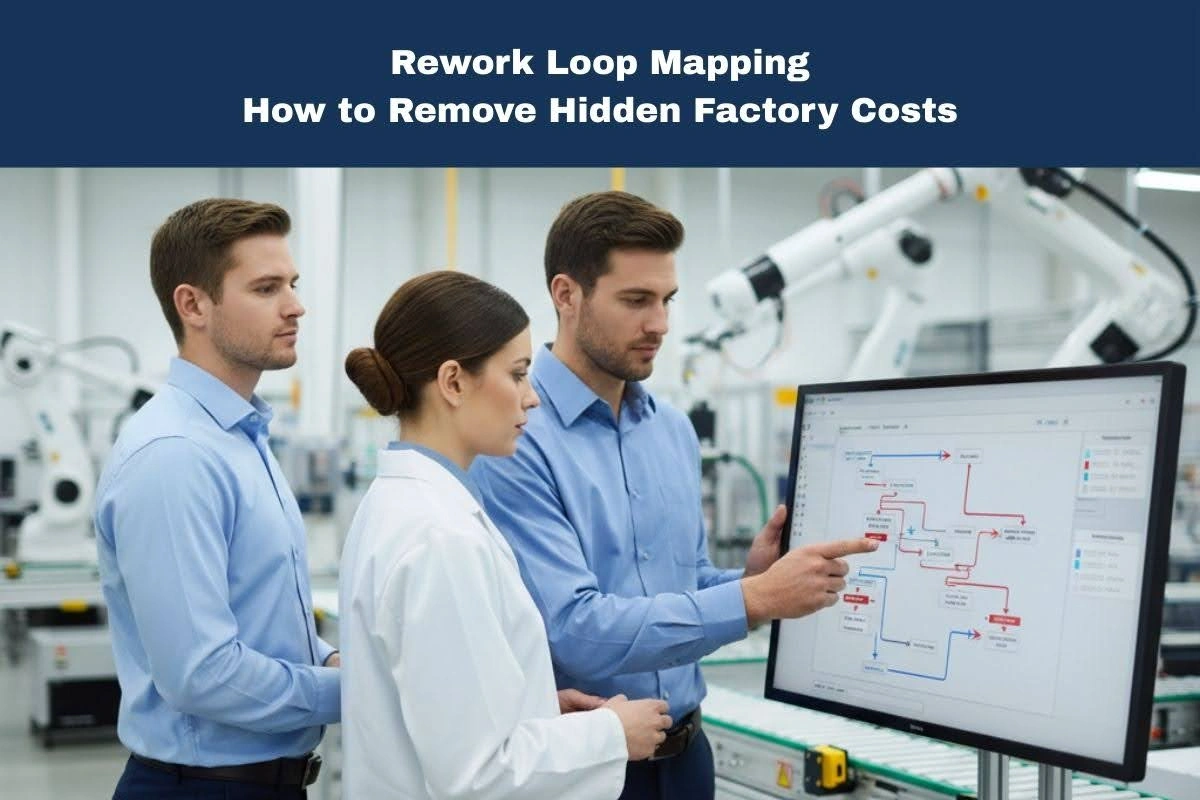
Rework loop mapping is a powerful operational tool that exposes these hidden costs. By visualizing where defects occur and how materials flow back through processes, organizations can eliminate waste, improve quality, and unlock significant financial gains.
This guide explores what rework loop mapping is, why it matters, how to conduct it effectively, and how to remove hidden factory costs at their root.
What Is Rework in Manufacturing and Why It Matters
Rework occurs when a product fails to meet quality standards and must be corrected before shipment. It differs from scrap in that the item is repaired or modified rather than discarded.
Common causes of rework include:
- Process variability
- Poor operator training
- Equipment misalignment
- Incomplete specifications
- Inadequate quality checks
- Communication breakdowns
- Design flaws
- Supplier inconsistencies
While rework may seem manageable if defect rates are low, its cumulative impact is often substantial.
The True Cost of Rework
Rework costs extend far beyond the immediate repair activity. Hidden factory costs associated with rework include:
1. Labor Reallocation
Operators must pause current tasks to fix defective units, disrupting workflow and increasing overtime.
2. Machine Time Consumption
Equipment is used twice, once for initial production and again for correction.
3. Material Waste
Additional components, consumables, and energy are required during repair.
4. Production Bottlenecks
Rework competes with new production for capacity.
5. Increased Lead Time
Rework delays shipments and impacts delivery performance.
6. Administrative Burden
Engineering, quality, and management resources are consumed in analysis and reporting.
7. Morale Impact
Frequent rework frustrates employees and lowers engagement.
8. Customer Risk
If rework is rushed, escaped defects may reach customers.
These costs are often unaccounted for in traditional metrics, masking their true financial impact.
What Is Rework Loop Mapping?
Rework loop mapping is a process visualization technique used to:
- Identify where defects originate
- Track the flow of defective units
- Measure rework frequency
- Quantify time and cost impact
- Reveal systemic process weaknesses
It builds on value stream mapping principles but adds feedback loops that show how materials cycle backward through processes.
Instead of a linear flow, rework loop mapping shows circular paths where defects re-enter the system.
Why Traditional Metrics Miss Rework Costs
Standard production metrics often show:
- Units completed
- On-time delivery
- Scrap rate
But they rarely show:
- Rework hours per shift
- Capacity lost to correction
- Cost per defect
- Impact on schedule reliability
Because rework still results in shippable units, it appears productive, masking inefficiencies.
Rework loop mapping exposes this illusion.
Step-by-Step Guide to Rework Loop Mapping
Rework loop mapping becomes much easier when broken into clear, practical steps, starting with documenting the current process flow and then tracing where defects create repeat cycles.
Step 1: Select a Product Family or Line
Start with a high-volume or high-margin product line. Focus where rework impact is likely greatest.
Step 2: Create the Baseline Process Map
Map the entire production flow from raw material to shipment:
- Process steps
- Cycle times
- Inspection points
- Transportation
- Queues
This establishes the normal forward flow.
Step 3: Identify Defect Points
At each process step, document:
- Defect types
- Frequency
- Detection location
- Correction method
Ask:
- Where are defects discovered?
- Are they detected immediately or later?
- How far do defective units travel before discovery?
Step 4: Draw Rework Loops
Add arrows that show:
- Where defective units go
- Whether they return to the same station
- Whether they move to a rework cell
- Whether engineering must intervene
This creates visible feedback loops.
Step 5: Quantify Rework Impact
Measure:
- Rework time per unit
- Total rework hours per shift
- Additional machine utilization
- Added material costs
- Overtime required
Convert time into financial impact.
Step 6: Analyze Patterns
Look for:
- Repeating defect categories
- Concentrated rework zones
- Late-stage defect detection
- Cross-department involvement
Patterns reveal systemic weaknesses.
Common Types of Rework Loops
Recognizing these common rework loop patterns allows organizations to identify recurring sources of inefficiency and prioritize corrective actions that will deliver the greatest operational and financial impact.
1. Immediate Loop
Defect detected at same station; corrected immediately.
2. Downstream Loop
Defect discovered later; product travels backward through the system.
3. Engineering Loop
Product requires redesign input before correction.
4. Customer Return Loop
Defect discovered post-shipment; product returns for repair.
Each type carries escalating cost and risk.
Hidden Factory Costs Revealed
Rework loop mapping often uncovers:
- Excessive WIP buildup
- Underestimated capacity constraints
- Poor first-pass yield
- Quality inspection gaps
- Misaligned performance incentives
Factories may discover that up to 20% of labor capacity is consumed by rework activities.
Root Causes of Rework
Rework is rarely random. Common systemic drivers include:
Process Instability
Lack of standardized work or control parameters.
Inadequate Training
Operators lack understanding of specifications.
Design Complexity
Products too complex for current capabilities.
Poor Communication
Specification changes not cascaded properly.
Misaligned Metrics
Incentives reward speed over quality.
Addressing these causes removes loops permanently.
Strategies to Remove Rework Loops
Eliminating rework loops requires a proactive approach that focuses on prevention, process control, and continuous improvement rather than simply correcting defects after they occur.
1. Improve First-Pass Yield
Focus on right-first-time production.
2. Move Detection Upstream
Detect defects earlier where correction cost is lower.
3. Standardize Work Instructions
Reduce operator variation.
4. Invest in Process Control
Use statistical monitoring to detect drift.
5. Redesign for Manufacturability
Simplify complex designs.
6. Strengthen Supplier Quality
Eliminate upstream defect sources.
7. Implement Error-Proofing (Poka-Yoke)
Prevent mistakes before they occur.
Financial Impact of Rework Reduction
Removing rework loops delivers:
- Increased productive capacity
- Reduced overtime
- Improved on-time delivery
- Lower warranty costs
- Higher margins
- Improved employee morale
Often, eliminating rework frees capacity equivalent to adding new equipment—without capital investment.
Case Example
A mid-sized manufacturer mapped its assembly line and discovered:
- 14% of units required rework
- 18% of labor hours were spent correcting defects
- 22% of defects were detected at final inspection
By moving quality checks upstream and standardizing torque settings, the company:
- Reduced rework to 5%
- Increased available capacity by 12%
- Improved on-time delivery from 89% to 97%
- Saved over $450,000 annually
How Can Manufacturers Shift From Reactive Fixes to Proactive Quality?
In many manufacturing environments, rework gradually becomes accepted as a normal part of production. Teams grow accustomed to fixing defects after they occur rather than questioning why they happened in the first place. This reactive mindset quietly sustains inefficiencies and hidden costs.
A meaningful transformation requires a cultural shift:
From:
"We'll fix it later."
To:
"Why did it happen in the first place, and how do we prevent it?"
Rework loop mapping supports this shift by making defects visible and quantifiable. When teams can clearly see how much time, capacity, and profit are lost to correction cycles, the focus naturally moves toward prevention, process stability, and root-cause elimination.
Strengthening process controls and preventing defects at the source requires a structured approach to quality. Read Quality Assurance Methods that help manufacturers improve consistency, reduce risk, and drive sustainable performance improvements.
How Can Rework Mapping Be Integrated Into Continuous Improvement?
Rework loop mapping should not be a one-time exercise. It is most effective when integrated into broader operational excellence initiatives.
It can be incorporated into:
- Lean transformation efforts
- Six Sigma problem-solving projects
- Kaizen improvement events
- Operational excellence and quality programs
By reviewing rework maps regularly, organizations can track progress, validate improvements, and prevent regression. Continuous visibility ensures that gains are sustained and that new inefficiencies are quickly identified.
How Digital Solutions Enhance Rework Analysis and Control
Modern manufacturing systems provide powerful tools that enhance the effectiveness of rework analysis. Digital integration allows organizations to move from reactive reporting to proactive control.
Advanced tools enable:
- Real-time defect tracking and categorization
- Automated first-pass yield monitoring
- Predictive quality analytics to anticipate failures
- Interactive dashboards that visualize rework trends
Digital visibility increases accountability, improves decision-making speed, and ensures that quality data is accessible across departments.
How Do You Measure the Impact of Rework Reduction?
To ensure continuous improvement, organizations must measure performance using clear, relevant indicators. Key metrics include:
- First-pass yield
- Rework rate
- Cost of poor quality (COPQ)
- Overall equipment effectiveness (OEE)
- Production lead time
- Customer return rates
Tracking these metrics provides objective evidence of improvement and highlights areas requiring additional focus.
What Are the Long-Term Benefits of Eliminating Rework Loops?
When rework loops are systematically reduced or eliminated, the benefits extend far beyond cost savings.
Organizations gain:
- More stable and predictable production schedules
- Greater cost transparency and control
- Increased throughput without additional capital investment
- Improved employee morale and engagement
- Stronger customer trust through consistent quality
- Sustainable competitive advantage
Over time, rework reduction transforms from a quality initiative into a powerful profit driver. By freeing hidden capacity and eliminating waste, factories can achieve higher efficiency, stronger margins, and long-term operational resilience.
Health and safety performance directly influences operational efficiency and long term cost stability. To better understand the broader financial landscape, explore our guide on Manufacturing Costs in Mexico, where we break down the key factors shaping production expenses and competitiveness.
AMREP Mexico: Turns Operational Visibility Into Performance
Rework is one of the most expensive yet overlooked inefficiencies in manufacturing. Because corrected products still ship, its true cost often remains hidden within standard performance metrics. Rework loop mapping provides clarity by exposing feedback cycles, uncovering root causes, and making hidden costs visible.
By systematically eliminating rework loops, manufacturers can recover lost capacity, improve quality, reduce lead times, and strengthen profitability. The objective is not just to fix defects faster, but to prevent them from occurring.
At AMREP Mexico, our Production Management Solutions are designed to turn operational visibility into measurable performance gains. Through structured process analysis and continuous improvement strategies, we support manufacturers in transforming reactive operations into efficient, high performance systems built for sustainable growth.