Medical Device Manufacturing in Mexico: COFEPRIS and ISO 13485 Supplier Quality Requirements
Medical device manufacturers in Mexico operate under two parallel compliance obligations: COFEPRIS regulatory authorization and an ISO 13485 supplier quality management system. Miss either one and you face registration delays, failed audits, or production holds.
This guide covers COFEPRIS registration routes, NOM-241-SSA1-2025 GMP requirements, ISO 13485 design controls, clean room standards, technovigilance obligations, and the supplier quality risks specific to Mexico's manufacturing environment.
What Is COFEPRIS and Why Does It Govern Your Supply Chain?
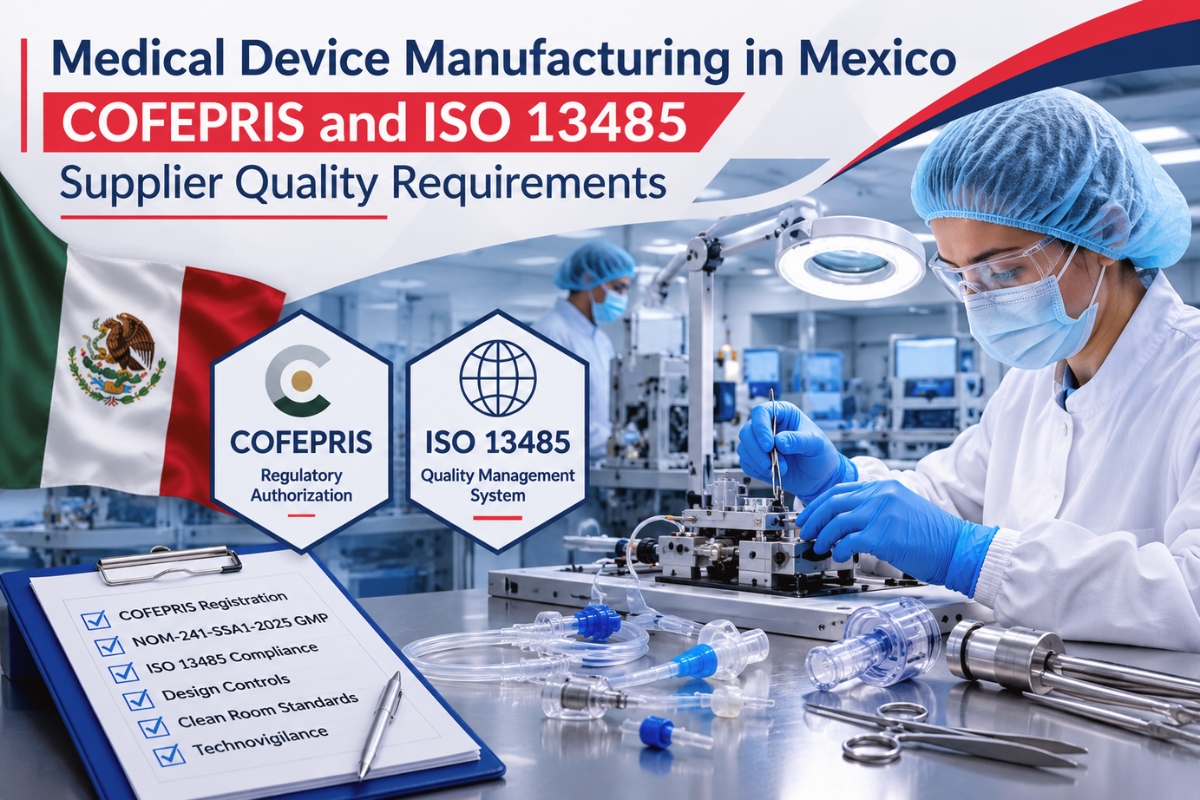
COFEPRIS (Comisión Federal para la Protección contra Riesgos Sanitarios) is Mexico's Secretariat of Health division that regulates medical device manufacturing, importation, labeling, and post-market surveillance. It is Mexico's functional equivalent of the U.S. FDA.
Compliance is enforced through three pillars:
- General Health Law (Ley General de Salud): Overarching legal framework for medical devices and pharmaceuticals
- Regulations of Health Supplies (Reglamento de Insumos para la Salud): Specific device authorization, manufacturing, and distribution requirements
- NOMs (Normas Oficiales Mexicanas): Mexico's technical standards, including NOM-241-SSA1-2025 for Good Manufacturing Practices
Every supplier in your Mexican supply chain must operate within this framework, not only your own facility.
COFEPRIS Medical Device Classification
Device class determines the registration route, documentation, audit obligations, and review timelines.
- Class I: Low-risk, generally not introduced into the body. Bandages, gloves, reflex hammers.
- Class II (IIa and IIb): Moderate-risk, may contact or enter the body for limited periods. The largest device category in Mexico.
- Class III: High-risk implantables and life-sustaining devices requiring the most rigorous registration path.
In July 2025, COFEPRIS published its first update to the low-risk device list in over a decade, reorganizing devices into three regulatory annexes. Misclassification forces complete resubmission and restarts the review clock. Verify classification against the current agreement before any registration work begins.
COFEPRIS Registration in 2025 and 2026: Routes, Timelines, and Pre-filing Requirements
Standard Registration Route
Requires a complete technical dossier including:
- Device description and design specifications
- Clinical evidence of safety and efficacy
- ISO 13485 or equivalent QMS documentation
- Spanish-language labeling per NOM-137-SSA1-2008
- GMP compliance evidence and risk analysis
Review timelines: 30 days for Class I, up to six months or more for Class III.
Abbreviated (Equivalency) Route — Effective September 1, 2025
Fast-track pathway for manufacturers holding approval from IMDRF or MDSAP-recognized authorities:
- U.S. FDA (Classes I, II, and III)
- Health Canada
- European Medicines Agency (EU MDR)
- Japan Ministry of Health, Australia's TGA, Swissmedic
Manufacturers submit a summary dossier. COFEPRIS targets a 30-day review window. For FDA-cleared devices with ISO 13485 certification, approval timelines have compressed from six months to weeks.
January 2026 Renewal Reform
Second and subsequent renewals can now be granted for up to ten years. First renewals still require full documentation, including GMP certification and a technovigilance report. Initial registrations remain valid for five years.
Pre-filing Requirements
Mexico Registration Holder (MRH)
All foreign manufacturers must appoint a locally established MRH before any registration proceeds. The MRH:
- Submits dossiers and pays government fees
- Holds the sanitary registration in its own legal name
- Manages post-market reporting with COFEPRIS
Registrations are issued to the MRH, not the foreign manufacturer. Transferring to a new MRH takes months. Vet the relationship before committing.
GMP Evidence
Acceptable proof: ISO 13485 certification, CE Mark under EU MDR, MDSAP certificate, or GMP certificates from recognized authorities. ISO 13485 satisfies NOM-241-SSA1-2025 through an established equivalency pathway, eliminating the need for a separate Mexican GMP inspection.
Spanish Labeling
NOM-137-SSA1-2008 requires: generic device name, country of origin, registration number, expiration date, serial or lot number, and manufacturer identification. All labels must be in Spanish.
NOM-241-SSA1-2025: Mexico's Updated GMP Standard
Effective April 2025, NOM-241-SSA1-2025 replaces NOM-241-SSA1-2012. Key changes:
- Device classification chapter removed, now governed under a separate agreement
- Sample retention requirements consolidated into one section
- Aligned with the Mexican Pharmacopoeia for classification rules
NOM-241 covers every production stage from facility design through distribution. Its core requirement is a documented, implemented, and maintained QMS across the full production cycle. Manufacturers certified to ISO 13485 satisfy most NOM-241 requirements through the equivalency pathway.
ISO 13485 Supplier Quality Management in Mexico
ISO 13485 is the QMS standard COFEPRIS treats as the GMP benchmark. It governs not just your own facility but every supplier in your chain. Even when production steps are outsourced, the manufacturer remains fully responsible for ensuring outsourced activities meet the same requirements as internal processes.
ISO 13485 supplier quality requirements:
- Documented criteria for evaluating, selecting, and re-evaluating suppliers
- Clear purchasing specifications communicated before production begins
- On-site audits for critical and high-risk suppliers
- Ongoing performance monitoring using defined quality metrics
- Formal CAPA processes when supplier performance deviates
- Complete material and component traceability throughout the supply chain
- Device History Records maintained for every unit produced
In February 2024, the FDA aligned 21 CFR Part 820 with ISO 13485:2016. Manufacturers already operating under the FDA's Quality System Regulation have quality infrastructure that maps directly to Mexico's requirements.
ISO 13485 Design Controls and APQP: The Most-Audited Clause in Mexico
ISO 13485 Section 7.3 is consistently among the most-cited nonconformances during COFEPRIS and FDA inspections of Class II and Class III devices manufactured in Mexico.
Design controls require:
- Design and development planning with defined stages, responsibilities, and review requirements
- Design inputs capturing functional, performance, safety, and regulatory requirements
- Design outputs, including drawings and production documentation that reference inputs
- Design reviews at defined stages with cross-functional participation
- Design verification confirming outputs meet input requirements
- Design validation confirming the device meets defined user needs
- Design transfer documentation ensuring production specifications translate accurately from design to manufacturing
- Change control requiring re-verification and re-validation when changes affect safety or performance
For OEMs sourcing from Mexican suppliers who were not involved in the original device design, design transfer documentation is the most frequently missing element. Suppliers who receive only drawings without the upstream design history create traceability gaps that surface directly in COFEPRIS inspections.
APQP and PPAP in Mexico's Medical Device Supply Chain
Many Mexican medical device suppliers carry APQP experience from automotive programs. The five APQP phases map directly to ISO 13485 design controls:
- Phase 1 (Plan and Define): ISO 13485 design inputs and planning
- Phase 2 (Product Design and Development): design outputs and verification
- Phase 3 (Process Design and Development): process validation requirements
- Phase 4 (Product and Process Validation): design validation and PPAP submission
- Phase 5 (Launch and Continuous Improvement): post-production monitoring and CAPA
Deploying APQP at Mexican medical device suppliers is one of the fastest ways to build ISO 13485 compliance at a facility already fluent in structured quality planning.
Clean Room Requirements for Medical Device Manufacturing in Mexico
Clean room infrastructure is mandatory for Class II and Class III device manufacturing and most sterile device assembly. Mexico's medical device clean rooms must comply with ISO 14644 classifications.
Requirements by device category:
- ISO Class 8 (former Class 100,000): Non-sterile device assembly, final packaging, electronic sub-assembly
- ISO Class 7 (Class 10,000): Assembly of devices contacting tissue, blood, or body fluids
- ISO Class 5 (Class 100): Direct sterile fill, open container handling, critical implantable sub-assembly
Clean room validation and ongoing monitoring requirements under ISO 14644 and ISO 13485:
- Initial qualification covering particulate count, air change rate, differential pressure, temperature, and humidity
- HEPA filter integrity testing at installation and on a recertification schedule
- Ongoing viable and non-viable particle monitoring at defined sample points and frequencies
- Personnel gowning qualification and training records
- Cleaning and disinfection validation for all controlled surfaces
- Equipment IQ/OQ/PQ for equipment operating within the clean room
- Environmental monitoring trend analysis maintained within the QMS
Many Mexican suppliers have clean rooms that were validated at commissioning and never recertified. A facility that passes visual inspection can still fail a COFEPRIS audit if environmental monitoring records do not demonstrate ongoing compliance. Request clean room validation documentation at the start of supplier qualification, not at the end.
Sterilization Validation Requirements
ISO 13485 clause 7.5 mandates documented validation for any process whose output cannot be verified by subsequent inspection. Sterilization falls entirely in this category. It must be validated before commercial production begins.
Required documentation:
- IQ, OQ, and PQ for all sterilization equipment
- Validated bioburden testing on production-line device samples
- Sterility assurance level (SAL) at 10⁻⁶ or better for implantables and Class III devices
- Revalidation protocols triggered by changes to the device, packaging, or sterilization process
- Sterilization records maintained within every Device History Record
Mexican suppliers without prior sterile device production experience frequently lack IQ/OQ/PQ documentation entirely. Assuming a process is validated without reviewing the underlying records is one of the fastest routes to a COFEPRIS audit finding.
COFEPRIS Technovigilance: What Post-Market Surveillance Requires in Practice
Technovigilance is governed under NOM-240-SSA1, currently in the final draft phase after public comment closure in September 2024. It applies throughout the entire commercial life of a registered device.
Adverse Event Reporting Timelines
- Serious adverse events (death or serious injury): reported within 10 calendar days of awareness
- Non-serious adverse events and near-miss incidents: reported within 30 calendar days
- Periodic safety update reports required at defined intervals throughout the registration period
Field Safety Corrective Actions (FSCAs)
COFEPRIS must be notified before any FSCA is initiated. Notification must include:
- Device description and identified risk
- Affected product scope (lot numbers, date ranges, distribution territories)
- Corrective action plan and implementation timeline
- Customer and healthcare facility communication plan
Ongoing System Requirements
Manufacturers must maintain a technovigilance system that captures complaint data, reviews adverse event trends on a defined schedule, and connects findings to CAPA when trends indicate systemic issues. COFEPRIS inspectors verify that data is being captured consistently and reviewed, not just that the procedure document exists.
IMMEX and COFEPRIS: How the Two Programs Interact
IMMEX (Industrial Manufacturing, Maquiladora, and Export Services) allows temporary duty-free importation of raw materials, components, and equipment for exported finished goods. It is the standard operating framework for medical device OEMs in Mexico.
Key intersections with COFEPRIS compliance:
- IMMEX authorization does not substitute for COFEPRIS registration. Both are required through separate agencies.
- IMMEX production is still subject to NOM-241-SSA1-2025 GMP requirements for devices sold in the Mexican domestic market.
- IMMEX-certified campus facilities can reach production status in 30 to 60 days. Standalone entity setup requires 6 to 12 months.
- IMMEX duty exemptions do not apply to production equipment that is not exported with or incorporated into the finished product.
Neither COFEPRIS nor the Secretariat of Economy will identify compliance gaps between the two programs proactively. Understanding both is the manufacturer's responsibility.
Want to know more about IMMEX? Read our guide on Mexico’s IMMEX Program overview
Supplier Quality Risks Specific to Mexico's Medical Device Environment
Traceability gaps at tier-two and tier-three suppliers
Mexican suppliers who source sub-components from smaller local vendors often have no formal lot-tracking system for those inputs. The OEM bears the full traceability obligation regardless of where the gap occurs.
Unvalidated production processes
Molding, welding, bonding, sterilization, and software-controlled assembly all require formal IQ/OQ/PQ documentation under ISO 13485. Many mid-sized Mexican suppliers run these processes without it.
Design transfer documentation missing at supplier level
Suppliers frequently receive only the latest drawing revision without the design history file, verification records, or validation data. COFEPRIS inspectors request design transfer documentation when verifying that the device in production matches the registered design.
Clean rooms that exist but are not maintained
A facility built to ISO Class 7 at commissioning without periodic environmental monitoring, filter recertification, or gowning requalification is not a compliant clean room. The gap becomes critical when inspectors review monitoring records.
CAPA systems that exist on paper only
COFEPRIS inspectors verify that CAPAs have been opened, investigated, actioned, and closed within defined timelines. Informal correction processes do not satisfy this requirement.
Language and technical communication barriers
Language gaps and different quality culture assumptions create delays between identifying a problem and implementing a verified corrective action.
Before your COFEPRIS inspection surfaces these gaps, reviewing the must-check areas in an ISO 13485 supplier audit gives your team a structured checklist of exactly what auditors verify at medical device facilities in Mexico.
What a Compliant ISO 13485 Supplier Quality Program Looks Like in Mexico
Supplier Qualification and Auditing
- Conduct capability assessments before awarding business
- Perform on-site supplier audits covering ISO 13485, NOM-241, design controls, and clean room validation
- Verify process validation records, calibration systems, and document control
- Review open and closed CAPAs to confirm system functionality, not just procedure documentation
- Confirm sterilization validation IQ/OQ/PQ and clean room monitoring records
Incoming and In-Process Quality Control
- Inspect materials and components at incoming inspection with full lot traceability
- Conduct during-production quality inspections at critical process stages from the control plan
- Document all inspection results in a format that supports Device History Record requirements
Supplier Development and Quality Engineering
- Deploy on-site supplier quality engineers to build CAPA systems, establish design transfer documentation, implement APQP and FMEA, and drive measurable improvement
- Train supplier staff on ISO 13485 documentation requirements and design control obligations
- Establish supplier scorecards with defined quality, delivery, and CAPA closure metrics
Production Management and Data Oversight
- Apply production management oversight to maintain process discipline and audit readiness between formal audit cycles
- Collect and analyze supplier quality data using Pareto analysis to prioritize development resources
- Support supplier sourcing decisions with quality capability assessments before new relationships begin
A Real Production Scenario: The Cost of No Local Quality Engineering
A U.S. orthopedic OEM sourced precision-machined components from a Tijuana supplier for a Class II implant assembly. The supplier held ISO 9001 but had no ISO 13485 compliance, no CAPA system, no design transfer documentation, and no Device History Record process.
A remote pre-shipment audit passed the supplier based on self-attested inspection records. When AmrepMexico's engineers deployed on-site, they identified dimensional non-conformances on a critical mating surface masked by uncalibrated gauges in the supplier's measurement system.
Corrective action required:
- Full measurement system analysis (MSA) of the supplier's gauge inventory
- Process capability study on the affected machining operations
- Retroactive lot segregation and reinspection of 14 prior shipments
- Documented CAPA with root cause, correction, and preventive action verified by follow-up audit
- Design transfer documentation review confirming production drawings matched the registered design
The cost of resolution exceeded what on-site quality engineering oversight would have cost from program launch. The OEM's COFEPRIS registration also required supplier control evidence and design transfer documentation that did not exist at the original submission. The gap was not in product performance. It was documentation discipline, process validation, and design control infrastructure.
Structured ISO 13485 medical device audit preparation at your Mexican supplier facilities closes these gaps before a COFEPRIS inspector or OEM auditor finds them.
Mexico's Nearshore Compliance Advantage
- On-site supplier audits and production witnessing without the time zone and travel burden of Asian facilities
- Real-time engineering decisions in the same or adjacent time zone when quality issues require immediate response
- COFEPRIS, FDA, IMDRF, and MDSAP regulatory alignment means compliance infrastructure built for the U.S. market transfers directly to Mexico
- Labor costs in Tijuana, Monterrey, and Guadalajara run 40 to 60 percent below comparable U.S. operations
Key manufacturing hubs:
- Tijuana and North Mexico: Highest concentration of medical device manufacturing in Mexico, with deep ISO 13485 regulated production experience
- Monterrey: High-complexity manufacturing, precision machining, and electromechanical assembly expertise
- Guadalajara: Electronics and advanced manufacturing for Class II diagnostic equipment
- Juárez and Chihuahua: Strong IMMEX-framework capacity serving U.S. OEMs across multiple device categories
Audit Your Mexican Medical Device Suppliers Against ISO 13485 and COFEPRIS GMP Requirements
AMREP Mexico Supplier Management Services has been offering ISO 13485 and GMP supplier audits across Mexico's medical device manufacturing corridors since 1994. Our lead auditors verify design control documentation, cleanroom validation status, CAPA system functionality, sterilisation validation records, and compliance with NOM-241-SSA1-2025 at your Mexican supplier facilities, with findings documented in accordance with OEM and regulatory standards.
We operate across Tijuana, Monterrey, Guadalajara, Mexico City, and every major industrial corridor in Mexico.
Frequently Asked Questions
Does COFEPRIS require ISO 13485 certification?
Not explicitly by law, but COFEPRIS requires QMS evidence in every registration application. ISO 13485 is the most widely accepted proof and satisfies NOM-241-SSA1-2025 GMP requirements through an established equivalency pathway. Manufacturers without it face additional scrutiny and typically require a separate COFEPRIS GMP inspection.
How long does COFEPRIS medical device registration take in 2026?
Standard Route: 30 days for Class I, up to six months or more for Class III. Abbreviated Equivalency Route (effective September 1, 2025): 30-day target for FDA, Health Canada, EU MDR, or other IMDRF-recognized approvals. Actual timelines depend on submission completeness and COFEPRIS workload.
What is a Mexico Registration Holder?
A legally established entity in Mexico that submits dossiers, manages COFEPRIS communications, and holds the sanitary registration in its own name—required for all foreign manufacturers. Transferring to a new MRH is a slow formal process, so evaluate the relationship carefully before committing.
What clean room classification is required?
ISO Class 8 for non-sterile assembly and packaging. ISO Class 7 for devices contacting tissue, blood, or body fluids. ISO Class 5 for sterile fill and critical implantable sub-assembly. All clean rooms must be validated under ISO 14644 with an ongoing environmental monitoring program maintained within the ISO 13485 QMS.
What does COFEPRIS technovigilance require?
Serious adverse events reported within 10 calendar days. Non-serious within 30 days. COFEPRIS notification is required before any Field Safety Corrective Action is initiated. Manufacturers must maintain a technovigilance system that captures complaint data, reviews trends on a defined schedule, and connects findings to CAPA. The system must be operational, not just documented.
What does COFEPRIS inspect during a facility audit?
NOM-241-SSA1-2025 GMP compliance across: documentation systems, process validation records, clean room monitoring data, design transfer documentation, calibration logs, CAPA systems, material traceability, personnel training records, and technovigilance records. Documentation completeness is consistently where facilities receive the most findings.
How does IMMEX interact with COFEPRIS?
They are separate programs run by different agencies. IMMEX governs duty-free importation under the Secretariat of Economy. COFEPRIS governs manufacturing compliance under the Secretariat of Health. Both apply simultaneously. Compliance with one does not satisfy the other.
How do ISO 13485 design controls apply to Mexican suppliers?
Section 7.3 requires documented design inputs, outputs, reviews, verification, validation, design transfer, and change control. For OEMs using Mexican suppliers, design transfer documentation is the most critical: suppliers must maintain the design history file, not just production drawings. Missing design transfer records are among the most common COFEPRIS inspection findings for Class II and III devices.