ISO 13485:201X Preparation (Medical Device Audits)
In the medical device industry patient safety, product reliability, and regulatory compliance are non-negotiable. ISO 13485 is a globally recognized standard for quality management systems (QMS) specific to medical devices.
With the transition from ISO 13485:2003 to the updated 201X revision (commonly implemented as ISO 13485:2016), organizations must adapt to enhanced requirements, particularly in risk management, regulatory alignment, and audit readiness.
This comprehensive guide explores everything you need to know about preparing for ISO 13485 audits, from understanding key changes to implementing a robust compliance strategy.
What Is ISO 13485? Scope, Importance, and Why It Matters in Medical Devices
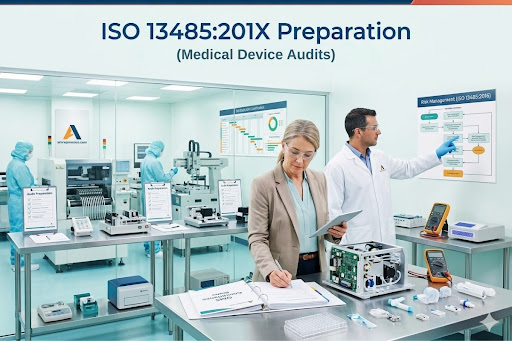
ISO 13485 is designed specifically for organizations involved in one or more stages of the medical device lifecycle, including:
- Design and development
- Production and manufacturing
- Installation and servicing
- Storage and distribution
Unlike general quality standards such as ISO 9001:2015, ISO 13485 emphasizes:
- Regulatory compliance
- Risk-based decision-making
- Product safety and effectiveness
Why ISO 13485 Certification Matters
Achieving ISO 13485 certification provides several strategic advantages:
- Global market access (EU, Canada, Australia, etc.)
- Regulatory compliance alignment
- Improved product quality and safety
- Enhanced customer trust
- Reduced risk of recalls and failures
Key Changes in ISO 13485:201X (2016 Revision)
Understanding the changes is critical for audit preparation. The updated standard introduced a more structured and risk-oriented approach.
1. Risk-Based Approach Across the QMS
Risk management is no longer limited to product design, it is embedded throughout the entire QMS.
Organizations must integrate risk into:
- Supplier evaluation
- Production processes
- Corrective and preventive actions (CAPA)
- Decision-making processes
Alignment with ISO 14971 is strongly expected.
2. Enhanced Regulatory Compliance
The revised standard requires organizations to explicitly:
- Identify applicable regulatory requirements
- Integrate them into QMS processes
- Maintain documentation proving compliance
This means your QMS must be tailored to specific markets (e.g., FDA, EU MDR).
3. Increased Documentation Requirements
Documentation is significantly more detailed and controlled.
You must maintain:
- Quality manuals
- Standard operating procedures (SOPs)
- Records of activities
- Document control systems
Auditors expect full traceability and version control.
4. Strengthened Supplier Controls
Supplier management is now risk-based and more rigorous.
Requirements include:
- Supplier qualification and re-evaluation
- Performance monitoring
- Defined responsibilities for outsourced processes
5. Improved Design and Development Controls
Organizations must demonstrate:
- Structured design planning
- Verification and validation
- Design transfer processes
Complete traceability from input to output is mandatory.
6. Post-Market Surveillance and Feedback
A stronger emphasis is placed on:
- Complaint handling
- Feedback collection
- Adverse event reporting
This ensures continuous monitoring of product performance in real-world conditions.
Types of ISO 13485 Audits
Understanding audit types helps you prepare effectively.
1. Internal Audits
- Conducted by your own organization
- Evaluate readiness and compliance
- Identify gaps before external audits
2. Supplier Audits
- Assess supplier capabilities and compliance
- Critical for outsourced processes
3. Certification Audits
Performed by a notified body in two stages:
Stage 1 Audit
- Review documentation
- Assess readiness
Stage 2 Audit
- Evaluate implementation
- Verify real-world effectiveness
Step-by-Step ISO 13485 Audit Preparation
Preparing for an ISO 13485 audit becomes far more manageable when the process is broken down into clear, practical steps that help your organization move from basic compliance to full audit readiness.
Step 1: Conduct a Gap Analysis
Compare your current QMS with ISO 13485 requirements.
Identify:
- Missing procedures
- Documentation gaps
- Non-compliant processes
Step 2: Develop or Update Your QMS
Your QMS should include:
- Quality manual
- SOPs aligned with ISO 13485
- Risk management integration
- Regulatory mapping
Step 3: Implement Risk Management
Risk must be documented and justified.
Actions include:
- Risk identification
- Risk evaluation
- Risk mitigation
- Residual risk analysis
Step 4: Strengthen Documentation Control
Ensure:
- Version control
- Approval workflows
- Change tracking
All documents must be accessible and up to date.
Step 5: Train Employees
Employees must:
- Understand their roles
- Be aware of QMS processes
- Demonstrate competence
Training records are mandatory for audits.
Step 6: Conduct Internal Audits
Internal audits should:
- Be systematic and planned
- Cover all QMS areas
- Identify non-conformities
Step 7: Implement CAPA System
A strong CAPA system must:
- Identify root causes
- Implement corrective actions
- Verify effectiveness
Weak CAPA is one of the most common audit failures.
Step 8: Prepare for the Certification Audit
Before the audit:
- Review all documentation
- Ensure records are complete
- Conduct mock audits
- Train staff for auditor interviews
Critical Areas Auditors Focus On
To successfully pass an ISO 13485 audit, it is essential to understand the specific areas auditors examine most closely, as these directly reflect the effectiveness and compliance of your quality management system.
1. Risk Management Integration
Auditors will check if risk is:
- Applied consistently
- Documented properly
- Linked to decisions
2. Traceability
You must demonstrate:
- Product traceability
- Process traceability
- Documentation traceability
3. Supplier Control
Auditors expect:
- Approved supplier lists
- Evaluation criteria
- Performance monitoring
4. Validation and Verification
Validation must be:
- Documented
- Scientifically justified
- Reproducible
5. Complaint Handling
Auditors review:
- Complaint logs
- Investigation processes
- Response timelines
Common Audit Findings (and How to Avoid Them)
Even well-prepared organizations encounter recurring audit issues, but recognizing these common findings early allows you to proactively close gaps and approach your audit with confidence.
1. Inadequate Risk Documentation
Risk management is often applied inconsistently or not clearly documented across processes.
How to Avoid It:
Integrate risk management into every relevant process, not just product design. Ensure risks are identified, assessed, and documented with clear justification and linkage to decisions.
2. Weak CAPA System
Corrective and Preventive Actions (CAPA) may lack proper root cause analysis or fail to demonstrate effectiveness.
How to Avoid It:
Use structured root cause analysis methods such as 5 Whys or Fishbone diagrams, and always include effectiveness checks to confirm that issues are fully resolved.
3. Poor Supplier Control
Organizations often fail to properly evaluate, monitor, or document supplier performance.
How to Avoid It:
Implement a risk-based supplier management system with defined qualification criteria, regular evaluations, and performance tracking.
4. Incomplete Validation
Validation activities may be insufficient, poorly documented, or lack scientific justification.
How to Avoid It:
Develop comprehensive validation protocols, document results clearly, and define when revalidation is required based on changes.
5. Documentation Gaps
Missing, outdated, or uncontrolled documents are one of the most common audit findings.
How to Avoid It:
Establish a robust document control system with version control, approval workflows, and regular reviews to ensure all documentation remains accurate and audit-ready.
Most audit findings are not due to a lack of effort, but a lack of consistency. By strengthening these key areas, organizations can significantly reduce non-conformities and improve overall audit performance.
Building a Culture of Compliance
Achieving compliance with ISO 13485 goes beyond passing audits. It requires embedding quality into everyday operations so that compliance becomes a natural outcome, not a last-minute effort.
Organizations that build a strong compliance culture typically experience fewer audit issues, better efficiency, and stronger trust with regulators and clients.
Key Elements
1. Leadership Commitment
Quality must start at the top. Leadership should actively support the QMS, allocate resources, and set clear quality objectives.
2. Employee Involvement
Every employee should understand their role in maintaining quality. Ongoing training and open communication help prevent errors and improve accountability.
3. Continuous Monitoring
Regular internal audits, performance tracking, and process reviews ensure issues are identified and resolved early.
4. Accountability
Clear roles and ownership of processes ensure consistency and prevent gaps in compliance.
Tools and Technologies for Audit Preparation
Preparing for ISO 13485 audits becomes significantly more efficient when supported by the right tools and technologies. Modern organizations rely on digital systems to streamline processes, maintain accuracy, and ensure real-time compliance.
Commonly Used Tools
QMS Software
Centralizes quality processes, including CAPA, training, complaints, and document control, ensuring everything is audit-ready in one place.
Document Management Systems (DMS)
Helps manage version control, approvals, and secure storage of critical documents, reducing the risk of outdated or missing records.
Risk Management Tools
Supports risk identification, assessment, and mitigation in alignment with ISO 14971, making risk-based decisions easier to track and justify.
Audit Management Platforms
Enables planning, execution, and tracking of internal and external audits, including non-conformities and corrective actions.
Using the right technology not only improves efficiency but also enhances accuracy, traceability, and consistency across your QMS. This reduces human error, saves time during audits, and ensures your organization remains continuously prepared rather than reacting at the last minute.
Practical Audit Checklist
Before undergoing an ISO 13485 audit, it is essential to ensure that your documentation, records, processes, and supporting evidence are complete, accurate, and readily accessible. A well-prepared checklist helps you stay organized and minimizes the risk of non-conformities.
1. Documentation
Ensure all core documents are up to date, approved, and properly controlled:
- Quality Manual aligned with ISO 13485
- Standard Operating Procedures (SOPs)
- Risk management files and risk assessments
- Document control procedures with version history
2. Records
Verify that all critical records are complete, accurate, and easily retrievable:
- Employee training and competency records
- CAPA logs with root cause analysis and effectiveness checks
- Complaint handling records and investigation reports
- Internal audit reports
3. Processes
Confirm that key operational processes are clearly defined, implemented, and consistently followed:
- Supplier qualification, evaluation, and monitoring
- Design and development controls with full traceability
- Process validation and verification activities
- Change management procedures
4. Evidence of Compliance
Be prepared to demonstrate that your QMS is functioning effectively in practice:
- Product and process traceability
- Compliance with applicable regulatory requirements
- Risk-based decision-making across processes
- Performance monitoring and quality metrics
When your systems are organized and aligned, audit readiness becomes a continuous state rather than a last-minute effort.
Benefits of Proper ISO 13485 Preparation
Organizations that take a structured and proactive approach to preparing for ISO 13485 audits gain far more than just certification. Effective preparation strengthens the entire quality framework, leading to measurable improvements across operations, compliance, and product performance.
Key Benefits
Faster and Smoother Certification
Well-prepared organizations face fewer delays during audits, with clear documentation and processes that meet auditor expectations.
Reduced Non-Conformities
Identifying and addressing gaps early minimizes audit findings and the need for corrective actions.
Improved Operational Efficiency
Streamlined processes, clear responsibilities, and better documentation reduce redundancies and enhance productivity.
Enhanced Product Quality and Safety
A strong QMS ensures consistent product performance, reducing defects, recalls, and customer complaints.
Stronger Regulatory Compliance
Alignment with global regulatory requirements becomes more consistent, making it easier to enter and operate in multiple markets.
Proper ISO 13485 preparation is not just about passing an audit, it is about building a reliable, efficient, and compliant system that supports long term growth and credibility in the medical device industry.
To strengthen your supplier evaluation process, you can also refer to our detailed guide on supplier audit scoring systems and how to rate suppliers effectively using scorecards and criteria.
Challenges in ISO 13485 Implementation
Implementing ISO 13485 can be complex, especially for organizations transitioning from less regulated environments. Understanding common challenges and addressing them proactively can significantly improve implementation success.
1. Complexity of Requirements
ISO 13485 includes detailed and highly specific requirements, particularly around documentation, risk management, and regulatory alignment. This can feel overwhelming, especially for teams new to the standard.
Solution:
Break the standard into smaller sections and implement it step by step. Use a structured roadmap and focus on one process at a time to ensure clarity and proper execution.
2. Resource Constraints
Many organizations face limitations in terms of time, budget, and skilled personnel, which can slow down implementation and create gaps in compliance.
Solution:
Prioritize high-risk and high-impact areas first. Leverage digital tools and automation to reduce manual effort and improve efficiency without overloading your team.
3. Resistance to Change
Employees may resist new processes, documentation requirements, or additional responsibilities, especially if they do not fully understand the purpose behind them.
Solution:
Invest in training and clear communication. Involve employees early in the process and explain how compliance improves quality, reduces risk, and benefits the organization as a whole.
While these challenges are common, they are manageable with the right strategy. A phased approach, supported by training and the right tools, can turn implementation from a burden into a structured and achievable process.
Future Trends in Medical Device Audits
As the medical device industry evolves, audits aligned with ISO 13485 are becoming more dynamic, technology-driven, and globally integrated. Organizations must adapt to these emerging trends to stay compliant and competitive.
Key Trends Shaping the Future
Digital QMS Systems
Paper-based systems are rapidly being replaced by fully digital QMS platforms that offer better traceability, automation, and centralized control.
Real-Time Compliance Monitoring
Organizations are moving toward continuous compliance, using dashboards and live data to identify issues instantly rather than waiting for periodic audits.
Integration with Global Regulations
Increasing alignment with international regulations (such as EU MDR and FDA requirements) means organizations must maintain globally adaptable QMS frameworks.
Greater Focus on Cybersecurity
With the rise of connected medical devices, auditors are placing more emphasis on data security, software validation, and protection against cyber threats.
Data-Driven Decision Making
Advanced analytics and reporting tools are being used to track performance, predict risks, and support more informed quality and compliance decisions.
The future of medical device audits is shifting from periodic inspections to continuous, technology-enabled oversight. Organizations that embrace digital transformation and proactive compliance strategies will be better positioned to meet evolving audit expectations and regulatory demands.
For organizations operating in controlled environments, it is also important to understand how cleanroom standards align with quality systems, as explained in our guide on combining ISO 13485 and ISO 14644 in an audit.
Simplify ISO 13485 with AMREP Mexico
ISO 13485:201X audits updated standard demands a risk-based, documentation-driven, and regulation-aligned approach.
Organizations that invest in proper preparation, training, and system development will not only pass audits but also gain a competitive edge in the global medical device market.
Auditors are not just looking for documentation, they are looking for evidence of consistency, control, and commitment to quality.
If your systems reflect that, certification becomes a natural outcome, not a challenge.
At AMREP Mexico, we understand the complexities of medical device regulations and the challenges organizations face when preparing for ISO 13485 audits. Through our Supplier Quality services, and with the right guidance, structured approach, and industry expertise, compliance becomes a strategic advantage rather than a burden.