Supplier Audit Scoring System: How to Rate Suppliers (Scorecard + Criteria)
A supplier audit scoring system translates audit findings into quantifiable scores, enabling organizations to compare suppliers, prioritize corrective actions, and make informed sourcing decisions.
This blog provides a complete guide to supplier audit scoring systems, including:
- What a supplier audit scoring system is
- Why supplier scoring matters
- Key scoring models and approaches
- Supplier audit scorecard structure
- Audit criteria and weighting
- Score interpretation and supplier rating
- Best practices and common mistakes
What Is a Supplier Audit Scoring System?
A Supplier Audit Scoring System is a structured method used to evaluate a supplier’s compliance, performance, and risk level based on audit results. Instead of relying on qualitative judgments alone, the system assigns numerical values or ratings to audit criteria and findings.
The output is typically a supplier score or rating, which helps organizations:
- Measure supplier performance objectively
- Track trends over time
- Benchmark suppliers against one another
- Support sourcing and approval decisions
Why Supplier Audit Scoring Matters
It provides a clear, objective measure of supplier performance, risk, and compliance.
1. Objective Decision Making
Scoring removes subjectivity from audits by converting observations into measurable data. This ensures consistent evaluation across different auditors, sites, and suppliers.
2. Risk-Based Supplier Management
Not all suppliers present the same level of risk. A scoring system helps organizations identify high-risk suppliers and focus resources where they matter most.
3. Performance Comparison
With standardized scores, procurement and quality teams can compare suppliers objectively, even when they operate in different regions or industries.
4. Continuous Improvement
Scoring highlights weak areas and tracks improvement over time, encouraging suppliers to improve systems and performance.
5. Regulatory and Customer Confidence
Well-documented supplier scoring supports regulatory inspections and customer audits by demonstrating proactive supplier oversight.
Key Approaches to Supplier Audit Scoring
Organizations typically adopt one of the following scoring approaches, or a combination of them.
1. Percentage-Based Scoring
Each audit criterion is assigned a maximum score. The supplier’s final score is expressed as a percentage.
Example:
- Total possible score: 100
- Supplier score: 82
- Final rating: 82 percent compliant
This approach is simple and widely used.
2. Weighted Scoring System
Not all audit areas carry the same risk. In a weighted system, critical areas receive higher importance.
Example:
- Quality system: 40 percent
- Health and safety: 25 percent
- Compliance and ethics: 20 percent
- Documentation and records: 15 percent
Weighted scoring improves risk sensitivity.
3. Non-Conformity Based Scoring
Scores are reduced based on the number and severity of non-conformities.
Example:
- Minor NC: minus 5 points
- Major NC: minus 15 points
- Critical NC: minus 30 points
This approach strongly links scoring to risk severity.
4. Rating or Grade-Based System
Suppliers are classified into categories such as:
- Approved
- Conditionally approved
- Not approved
This system is often used alongside numerical scoring.
Supplier Audit Scorecard Overview
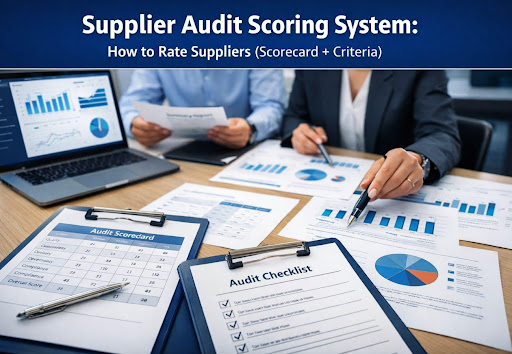
A Supplier Audit Scorecard is the tool used to capture audit results and calculate scores. It typically includes:
- Audit categories
- Evaluation criteria
- Maximum score per section
- Supplier score
- Weighting factor
- Final weighted score
- Overall rating
The scorecard should be simple, transparent, and repeatable.
Core Supplier Audit Scoring Criteria
While scoring systems vary by industry, most supplier audits assess similar core areas.
1. Quality Management System
Purpose:
To evaluate whether the supplier has a robust system to ensure consistent product or service quality.
Typical Criteria:
- Quality policy and objectives
- Document control
- Change management
- Internal audits
- Corrective and preventive actions
Scoring Considerations:
- System maturity
- Effectiveness of implementation
- Evidence of continuous improvement
Typical Weighting:
25 to 40 percent
2. Regulatory and Standard Compliance
Purpose:
To confirm compliance with applicable laws, regulations, and standards.
Typical Criteria:
- GMP compliance
- ISO certifications
- Legal registrations
- Regulatory inspections history
Scoring Considerations:
- Compliance gaps
- History of violations
- Regulatory readiness
Typical Weighting:
15 to 25 percent
3. Production and Process Control
Purpose:
To ensure processes are controlled, validated, and capable.
Typical Criteria:
- Process flow documentation
- Equipment qualification
- Process validation
- In-process controls
- Change control
Scoring Considerations:
- Process stability
- Control effectiveness
- Traceability
Typical Weighting:
15 to 25 percent
4. Materials and Supplier Management
Purpose:
To assess how the supplier manages its own suppliers and materials.
Typical Criteria:
- Supplier qualification
- Incoming inspection
- Traceability
- Inventory management
- Subcontractor control
Scoring Considerations:
- Risk control
- Transparency
- Supplier oversight
Typical Weighting:
10 to 20 percent
5. Documentation and Record Keeping
Purpose:
To confirm records are accurate, complete, and controlled.
Typical Criteria:
- SOP availability
- Record retention
- Data integrity
- Version control
Scoring Considerations:
- Accuracy
- Accessibility
- Consistency
Typical Weighting:
10 to 15 percent
6. Health Safety and Environment
Purpose:
To evaluate workplace safety and environmental responsibility.
Typical Criteria:
- Health and safety procedures
- Incident reporting
- Environmental controls
- Waste management
Scoring Considerations:
- Risk prevention
- Legal compliance
- Employee awareness
Typical Weighting:
5 to 15 percent
7. Ethics and Social Responsibility
Purpose:
To ensure ethical practices and social compliance.
Typical Criteria:
- Labor practices
- Code of conduct
- Anti-bribery controls
- Grievance mechanisms
Scoring Considerations:
- Ethical culture
- Compliance with codes
- Transparency
Typical Weighting:
5 to 10 percent
Example Supplier Audit Scorecard Structure
The following structure outlines key categories commonly used to evaluate supplier performance.
| Audit Area | Max Score | Weight | Supplier Score | Weighted Score |
|---|---|---|---|---|
| Quality Management | 40 | 0.30 | 34 | 10.2 |
| Compliance | 25 | 0.20 | 21 | 4.2 |
| Process Control | 20 | 0.20 | 16 | 3.2 |
| Materials Management | 15 | 0.15 | 12 | 1.8 |
| Documentation | 10 | 0.10 | 8 | 0.8 |
| Health and Safety | 10 | 0.05 | 9 | 0.45 |
| Total | 120 | 1.00 | — | 20.65 |
This scoring approach is most effective when combined with a strong onboarding process, as outlined in our article on how to conduct a technical evaluation of a new supplier in Mexico.
Interpretation of Supplier Audit Scores
After calculating the final score, suppliers are typically categorized.
Common Supplier Rating Bands
| Score Range | Supplier Status |
|---|---|
| 90–100% | Approved |
| 75–89% | Conditionally Approved |
| 60–74% | Restricted or Improvement Required |
| Below 60% | Not Approved |
These thresholds should be aligned with organizational risk tolerance.
Linking Scores to Corrective Actions
A scoring system should always connect to corrective action management.
Best Practices:
- Require CAPA for all major and critical findings
- Set deadlines based on severity
- Re-audit high-risk suppliers
- Track score improvement over time
Scores should drive action, not just reporting.
Using Supplier Scores for Business Decisions
Supplier audit scores support multiple decisions, including:
- Supplier approval or disqualification
- Increased inspection or surveillance
- Supplier development programs
- Contract renewal decisions
- Risk-based sourcing strategies
Best Practices for Designing a Supplier Audit Scoring System
These best practices help ensure scoring is fair, consistent, and aligned with business risk.
Keep It Simple and Transparent
Suppliers should understand how they are scored and how they can improve.
Focus on Risk Not Just Compliance
Higher weights should be assigned to areas that impact safety, quality, and compliance.
Ensure Consistency
Use the same scoring logic across suppliers and audits.
Train Auditors
Auditors must understand scoring criteria to avoid inconsistency.
Review and Improve the System
Periodically review scoring thresholds and weights based on performance trends.
Common Mistakes to Avoid
Avoiding these common mistakes helps ensure audit scores remain accurate and actionable.
Overcomplicating the scorecard
Including too many criteria or overly complex scoring scales can make the scorecard difficult to use and interpret. When auditors struggle to apply the system consistently, results become unreliable. A focused scorecard with clear, well-defined criteria is more effective and easier to maintain.
Treating all audit areas equally
Not all audit findings carry the same level of risk. Giving equal weight to minor documentation gaps and critical quality or safety issues can distort the overall score. Weighting audit areas based on their impact on quality, compliance, and business risk leads to more meaningful results.
Ignoring severity of findings
Failing to distinguish between minor, major, and critical findings reduces the value of the scoring system. Severity-based scoring ensures that high-risk issues are clearly reflected in the final score and receive appropriate attention and escalation.
Failing to follow up on low scores
A scorecard is only useful if it drives action. Ignoring low scores or not requiring corrective action plans undermines the purpose of the audit. Clear thresholds should trigger follow-up activities such as corrective actions, re-audits, or increased monitoring.
Using scores without context
Relying solely on numerical scores without considering the supplier’s history, improvement trends, or business criticality can lead to poor decisions. Scores should always be reviewed alongside qualitative observations and risk assessments to support balanced, informed decision-making.
To better understand the broader governance behind supplier evaluations, read our article on what supplier oversight is and why it matters.
AMREP Mexico: Elevates Supplier Audits Beyond Compliance
A well designed Supplier Audit Scoring System transforms supplier audits from simple compliance checks into a strategic supplier management tool. By using structured scorecards, risk-based criteria, and consistent scoring methods, organizations can objectively rate suppliers, prioritize improvements, and strengthen supply chain resilience.
At AMREP Mexico, we help organizations turn supplier audits into actionable insights that improve compliance, quality, and operational confidence.