How to Detect Health & Safety Risks with SA8000 Audits
SA8000 is widely known as a social accountability standard, but its Health & Safety requirements are concrete and operational: safe workplace conditions, hazard elimination/minimization, PPE, incident records, committees, training, emergency readiness, sanitation, potable water, and dormitory safety where applicable.
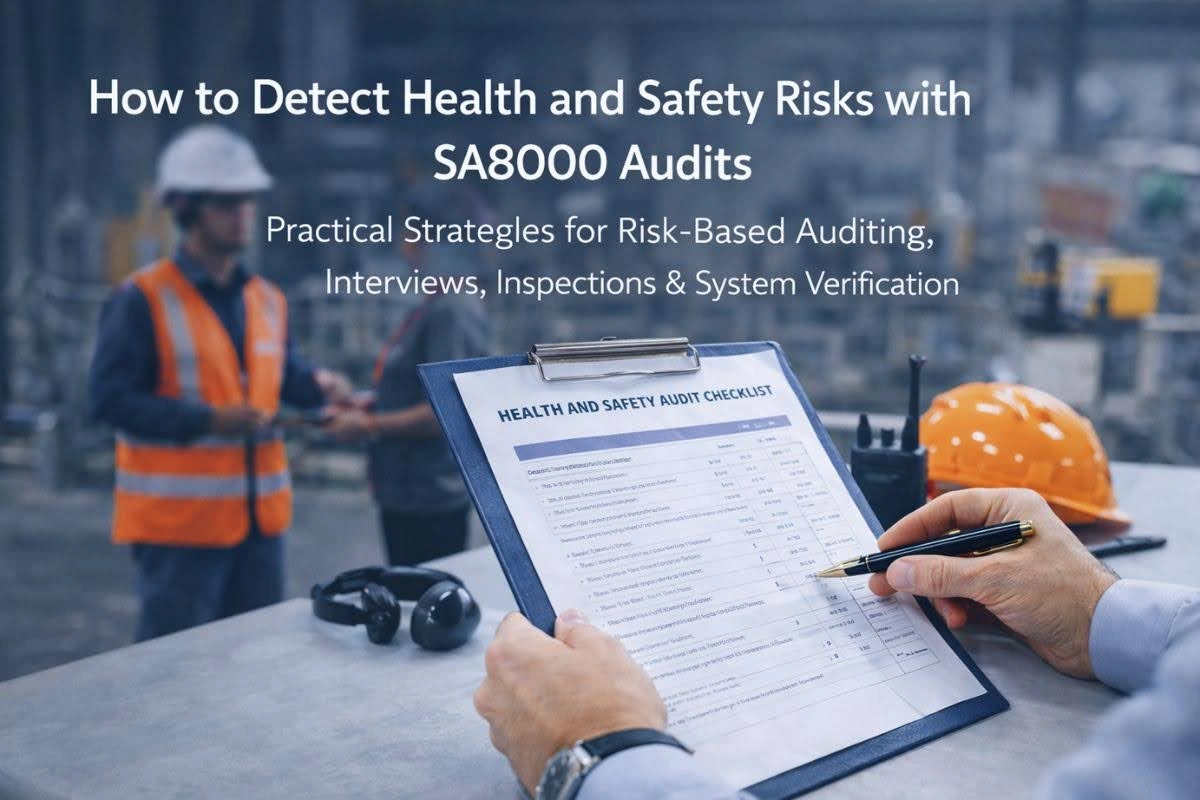
This blog shows how to use SA8000 audits to detect health and safety risks not as a paperwork exercise, but as a disciplined method to find hazards, test controls, and prove effectiveness in real working conditions.
What SA8000 actually expects on Health & Safety
The SA8000 Health & Safety section (Clause 3) sets a clear direction:
- Provide a safe and healthy workplace and take steps to prevent incidents and occupational injury/illness, minimizing or eliminating hazards where reasonably practicable.
- Assess risks to new, expectant, and nursing mothers, then remove or reduce risks.
- Provide PPE at the organization's expense when hazards remain; provide first aid and support access to follow-up medical treatment after injury.
- Appoint a senior management representative responsible for Health & Safety requirements.
- Establish a Health & Safety Committee (balanced worker/management), train it, and require it to conduct formal periodic OHS risk assessments and keep records of assessments and corrective/preventive actions.
- Provide effective H&S training regularly and when roles, incidents, or technology changes.
- Maintain documented procedures to detect/prevent/minimize/eliminate/respond to H&S risks and maintain written records of incidents (including incidents in residences/property provided by the organization).
- Ensure access to clean toilets, potable water, meal-break spaces, and where applicable sanitary food-storage facilities.
- Ensure any dormitories are clean, safe, and meet basic needs.
- Ensure workers can remove themselves from imminent serious danger without seeking permission.
The SA8000 Guidance Document reinforces the "management system" approach: start with hazard identification and risk assessment, build policies/procedures, ensure leadership and worker participation, implement controls using a hierarchy of controls, and gather evidence (records + worker understanding + physical conditions).
Why SA8000 audits are good at finding hidden safety risk
Many safety programs focus on compliance artifacts such as training sheets, PPE issue logs, and permits. SA8000 audits done well force triangulation across documents, interviews, and observation, which is where hidden risk shows up.
A typical SA8000 audit looks at whether systems are effective "on the floor," not only whether a policy exists. Certification assessment processes must address all SA8000 elements, and are expected to be performed through structured assessment requirements.
In practice, SA8000 audits expose three "blind spots" that factories often miss:
- Risk isn't where the KPI dashboard points. Injuries and near-misses cluster where work is rushed, improvised, or done by the least empowered workers (contractors, temporary, night shift).
- Controls drift. Guards removed "temporarily," PPE compliance declines, signage fades, procedures become outdated after layout/process changes.
- Workers know what management doesn't. Interviewing workers confidentially often reveals blocked exits, heat stress, chemicals without labels, coercion to work injured, or retaliation for raising safety issues.
How to Design SA8000 Audits That Detect Real Health and Safety Risks
Designing an effective SA8000 audit requires a shift in perspective. The goal is not simply to confirm compliance but to actively detect real health and safety risks before they cause harm.
This guide explains how to design and execute SA8000 audits that go beyond checklists and uncover real workplace hazards.
1. Adopt the Right Audit Mindset: Focus on Risk, Not Just Compliance
An effective SA8000 audit begins with the right mindset. The purpose is not to confirm that procedures exist. It is to determine whether workers are genuinely protected.
To detect health and safety risk, adopt the following principles:
1.1 Look for credible failure modes.
Ask yourself: if something goes wrong here, how would it happen? Where is the system
most vulnerable?
1.2 Test effectiveness, not paperwork.
If a procedure states inspections are conducted weekly, verify who performs them, review
recent records, and ask what corrective actions were taken when defects were found.
Confirm workers understand the control.
1.2 Follow the energy.
Heat, electricity, motion, chemicals, pressure, and gravity are the sources of severe
harm. Walk the process with these hazards in mind.
1.3 Prioritize high severity risks.
A factory may have many minor housekeeping issues, but a locked fire exit, an unguarded
press, or uncontrolled solvent exposure can lead to catastrophic outcomes. Your audit
must identify these critical risks first.
The most effective audits consistently seek evidence that controls are functioning in reality, not only on paper.
2. Plan the Audit Strategically for Maximum Risk Detection
Strong audits are built before the auditor ever steps onto the shop floor.
2.1 Map the Site Like a Risk Hunter
Before arriving on site, build a risk map that identifies:
- Major processes and equipment such as presses, conveyors, ovens, boilers, compressors, and forklifts
- Chemical usage including cleaning agents, adhesives, paints, plating, and coolants
- Human risk factors such as overtime peaks, new hires, contractors, language barriers, and night shifts
- Physical spaces including exits, stairwells, docks, confined spaces, and roof access
- Ancillary areas such as canteens, toilets, lockers, clinics, dormitories, and security gates
This preparation allows you to focus audit time where risk is most likely to exist.
2.2 Build a Smart, Risk Based Sampling Strategy
Sampling only the best performing shift or production line provides a distorted view.
A stronger sampling strategy includes:
- At least one high risk production area
- At least one support function such as maintenance or warehousing
- At least one non day shift
- A mix of permanent employees and contractors
- At least one new or reassigned worker
- A dormitory walkthrough if housing is provided
Sampling must reflect where risk actually exists, not where conditions are most polished.
3. Review Documents to Prove Controls Actually Work
Documentation is not the end goal. It is evidence that systems exist and are functioning.
3.1 Risk Assessments and Hazard Controls
Request:
- Current facility wide risk assessments
- Task specific risk assessments for high risk activities
- Action plans with assigned responsibilities
- Evidence that corrective actions were implemented and verified
If the risk assessment appears generic and does not match observed hazards, you have identified a detection gap.
3.2 Incident and Near Miss Systems
Review:
- Injury and illness logs
- Near miss reports
- Investigation records
- Root cause analysis documentation
- Corrective and preventive actions
Be cautious of facilities reporting zero incidents despite visible hazards or high overtime. This may indicate underreporting.
3.3 Training Effectiveness
Examine:
- Training matrices by role
- Induction programs for new hires
- Refresher training records
- Emergency drill records
Training records prove attendance, not understanding. Verification must continue through worker interviews.
3.4 Health and Safety Committee Governance
Confirm:
- Committee composition includes worker and management representatives
- Meeting minutes show active engagement
- Issues raised by workers are tracked and resolved
- Decisions are communicated to the workforce
Inactive or symbolic committees are a serious risk indicator.
3.5 Sanitation, Welfare, and Worker Facilities
Verify:
- Access to clean toilets and potable water
- Clean meal areas
- Food storage sanitation
- Dormitory conditions if applicable
Poor welfare conditions often correlate with weak overall safety culture.
4. Use Worker Interviews to Uncover Hidden Hazards
A SA8000 Health and Safety audit lives or dies on interview quality. Workers will tell you what the documents will not be if they trust you and feel safe.
4.1 Designing Effective Safety Interviews
Use a mix of:
- Direct yes or no questions with examples
- Experience based questions such as "Tell me about the last time…"
- Scenario based prompts such as "If there is a fire alarm during your shift, what happens?"
Confidentiality and trust are critical to obtaining honest responses.
4.2 Questions That Reveal Real Risk
Ask about:
- The most dangerous parts of the job
- PPE availability and cost
- Ability to stop unsafe work
- Incident reporting experiences
- Emergency drill participation
- Evacuation routes
- Treatment of pregnant or nursing workers
The depth and confidence of responses indicate the effectiveness of implementation.
4.3 Interview Red Flags You Should Never Ignore
- Workers afraid to report hazards
- Statements such as "training sheets are signed but no training happens"
- Unclear evacuation procedures
- PPE being shared or deducted from wages
- Workers stating they cannot leave unsafe areas
These signals often reveal deeper systemic failures.
5. Turn the Site Walkthrough into Structured Hazard Detection
The site walkthrough is where risk becomes visible.
5.1 The Five Lens Walkthrough Method
Examine the workplace through five lenses:
- People: fatigue, behavior, supervision, contractors
- Place: housekeeping, lighting, ventilation, exits
- Process: task sequence, pace, maintenance practices
- Plant: machinery, guarding, electrical systems
- Proof: signage, inspections, permits, calibration records
5.2 High Severity Risk Areas to Prioritize
Focus attention on:
- Fire exits and emergency egress
- Machine guarding and interlocks
- Electrical panels and wiring
- Chemical storage and labeling
- Ergonomic strain risks
- Heat stress management
- Contractor supervision
- Dormitory fire safety and sanitation
High severity risks must be addressed immediately if discovered.
6. Detect Underreporting Through Record Triangulation
Production pressure can discourage reporting.
Use triangulation techniques:
- Compare first aid logs with incident logs
- Compare absenteeism data with injury reports
- Compare maintenance records with hazard reports
- Compare PPE issuance with observed usage
- Compare overtime peaks with incident trends
Misalignment between these sources may reveal hidden risks.
7. Write Audit Findings That Drive Real Risk Reduction
Findings must clearly connect evidence to risk.
Include:
- Objective observation
- Location and timing
- Description of hazard
- Potential consequences
- Immediate containment actions
- Corrective and preventive measures
- Effectiveness verification plan
Well written findings prevent recurrence and strengthen systems.
8. Build a Risk Based Audit Cadence for Continuous Improvement
Safety risk detection must continue beyond certification.
Recommended cadence:
- Daily supervisor safety walks
- Weekly targeted inspections
- Monthly Health and Safety Committee reviews
- Quarterly internal SA8000 style audits
- Annual management review and emergency evaluation
Continuous oversight prevents control drift.
9. Common Pass on Paper Failures SA8000 Audits Must Catch
Watch for:
- Outdated risk assessments after layout changes
- PPE that is unsuitable or inconsistently used
- Committees that exist but lack authority
- Training that lacks practical understanding
- Underreported incidents
- Dormitory risks ignored due to outsourced management
These failures often appear compliant but hide serious risk.
10. A Practical Field Ready SA8000 Health and Safety Audit Checklist
Governance
- Senior health and safety representative appointed
- Active Health and Safety Committee
- Documented risk assessments and action tracking
Risk Controls
- Hazards minimized at source
- Appropriate PPE provided free of charge
- Machine guarding and electrical systems effective
Training
- Role specific and repeated training
- Workers understand emergency procedures
- Contractors included in induction
Incident Management
- Complete and credible incident records
- Root cause investigations
- First aid access and follow up support
Welfare
- Clean toilets and potable water
- Suitable meal areas
- Safe dormitories where applicable
Worker Voice
- Workers can remove themselves from imminent danger
- No retaliation for raising safety concerns
Strengthening health and safety systems often requires addressing underlying supplier performance gaps as well. Our guide on How to Solve Supplier Quality Issues in Mexico explains practical steps to identify root causes, implement corrective actions, and improve long term supplier reliability.
11. Turn Audit Results into Measurable Safety Performance Improvement
Audit findings should translate into measurable metrics such as:
- Percentage of high severity hazards closed within target timelines
- Repeat finding rate
- Near miss reporting volume and closure rate
- Corrective action effectiveness verification
- Emergency drill performance indicators
Tracking these metrics transforms audits from compliance events into performance drivers.
For a broader view on documenting supplier performance and structuring audit results effectively, explore our detailed guide on Supplier Audit Report Template: Format, Sections, and Example Findings.
AMREP Mexico: Transforms SA8000 Audits into Powerful Risk Prevention Tools
SA8000 audits do far more than confirm compliance. They integrate document review, worker voice, physical inspection, and system testing into a structured detection mechanism.
By triangulating risk assessments, controls, training, incident records, welfare conditions, and worker rights, organizations create an early warning system that identifies hazards before injuries occur.
The difference between a routine audit and a powerful safety intervention lies in design. When you focus on detecting real risk rather than confirming paperwork, SA8000 becomes not just a certification tool, but a safeguard for people and performance.
At AMREP Mexico, we align SA8000 audits with our broader Source Inspections and Quality Control Services to deliver a comprehensive approach that protects both people and operational integrity. We believe audits should do more than confirm compliance. They should actively uncover risk, strengthen systems, and protect the people who power your operations every day.
When designed and executed correctly, an SA8000 audit becomes a practical risk detection tool that prevents incidents, reduces liability, and builds long term operational resilience.
If your organization is ready to move beyond paperwork and build a truly risk focused health and safety culture, AMREP Mexico is here to support you.