5W2H of Process Audits: What You Should Know
The 5W2H framework provides a simple and structured way to improve process audits by answering seven key questions: What, Why, Where, When, Who, How, and How Much. This method helps businesses identify root causes, strengthen compliance, improve quality control, and implement effective corrective actions.
Widely used in automotive, aerospace, electronics, and manufacturing industries, the 5W2H approach supports better decision-making and continuous improvement.
This article explains how the 5W2H framework works in process audits, its key benefits, practical applications, and best practices for improving operational efficiency.
What Is a Process Audit?
A process audit is a systematic examination of operational processes to determine whether activities are performed in accordance with defined procedures, standards, and requirements.
According to the American Society for Quality (ASQ), businesses can lose between 15% and 20% of annual revenue due to poor quality, including rework, defects, downtime, and operational inefficiencies.
Process audits help organizations ensure that every operational step contributes to quality, efficiency, and customer satisfaction.
Process Audit vs Product Audit
Process audits and product audits both support quality management, but focus on different areas.
| Process Audit | Product Audit |
|---|---|
| Evaluates operational processes | Evaluates finished products |
| Focuses on workflows and compliance | Focuses on product specifications |
| Identifies process inefficiencies | Identifies product defects |
| Improves operational consistency | Verifies product quality |
Process audits improve how products are made, while product audits verify the final output.
Understanding the 5W2H Framework
The 5W2H methodology is a structured problem-solving and process analysis tool that originated in quality management and lean manufacturing systems.
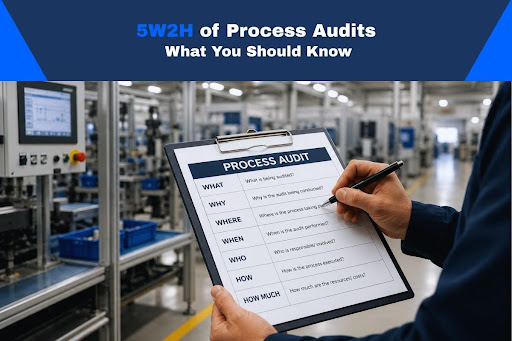
It is based on seven essential questions:
- What – Process or issue
- Why – Purpose or reason
- Where – Location or area
- When – Time or frequency
- Who – Responsible personnel
- How – Process execution
- How Much – Cost or impact
These questions provide a comprehensive approach to analyzing processes during audits.
The 5W2H method is widely used in:
- Lean manufacturing
- Six Sigma
- ISO quality management systems
- Root cause analysis
- Continuous improvement programs
- Supplier audits
- Internal quality audits
The 5W2H Questions Explained
The 5W2H framework breaks down process audits into seven essential questions.
1. What — What Is Being Audited?
The first step defines the exact process, activity, issue, or operation under evaluation.
Questions include:
- What process is under review?
- What standards apply?
- What are the expected outputs?
- What documents support the process?
- What problems are occurring?
Example
In an automotive assembly plant:
- Process audited: Torque verification on wheel installation
- Standard: OEM torque specification compliance
- Issue: Frequent wheel torque inconsistencies
This stage clearly establishes the audit scope.
2. Why — Why Is the Audit Necessary?
This question identifies the purpose behind the audit.
It helps auditors understand:
- Why the process matters
- Why failures occur
- Why compliance is critical
- Why is improvement needed
Common Reasons for Process Audits
- Customer complaints
- Product defects
- ISO certification requirements
- Supplier quality concerns
- Safety incidents
- Production inefficiencies
- Regulatory compliance
Example
A manufacturer may audit a welding process because:
- Defect rates increased by 15%
- Customers reported structural failures
- Internal inspections found inconsistencies
Understanding the “why” aligns the audit with business objectives.
3. Where — Where Does the Process Occur?
This step identifies the physical or operational location of the process.
Questions include:
- Where is the process performed?
- Where are defects occurring?
- Where are bottlenecks appearing?
- Where are materials stored?
- Where are risks highest?
Example
In electronics manufacturing:
- Soldering defects occur mainly at Line 3
- Component contamination occurs in one storage room
- Packaging delays happen in a specific shift area
This information narrows the audit focus.
4. When — When Does the Process Happen?
Timing is critical in process audits.
Questions include:
- When does the issue occur?
- When are inspections performed?
- When are deviations detected?
- When are maintenance activities completed?
- When are operators trained?
Example
A pharmaceutical company may discover:
- Deviations increase during overtime shifts
- Cleaning procedures are skipped during peak production
- Calibration delays occur monthly
Time-related analysis reveals operational patterns.
5. Who — Who Is Responsible?
This identifies all personnel involved in the audited process.
Questions include:
- Who performs the process?
- Who supervises it?
- Who approves quality checks?
- Who handles corrective actions?
- Who receives training?
Example
A process audit may reveal:
- Operators lack updated work instructions
- Supervisors are inconsistently enforcing procedures
- Maintenance teams are understaffed
This allows management to address organisational gaps.
6. How — How Is the Process Performed?
This is one of the most important stages of a process audit.
It examines:
- Process flow
- Work instructions
- Inspection methods
- Equipment usage
- Quality controls
- Documentation practices
Questions to Ask
- How is the process executed?
- How are measurements taken?
- How are deviations handled?
- How is quality verified?
- How are records maintained?
Example
In machining operations:
- Parts are measured manually instead of digitally
- Calibration procedures vary between shifts
- Operators use outdated process sheets
These inconsistencies can directly impact quality.
7. How Much — What Is the Cost or Impact?
The final component evaluates measurable impact.
This includes:
- Financial losses
- Downtime costs
- Scrap rates
- Rework expenses
- Compliance penalties
- Customer dissatisfaction
Example Metrics
- 8% scrap increase
- $50,000 monthly rework cost
- 20-hour production delay
- Increased warranty claims
This step helps prioritize corrective actions based on business impact.
How to Conduct a 5W2H Process Audit
Conducting a 5W2H process audit requires a structured approach to evaluate operations, identify gaps, and implement improvements effectively.
Below are the key steps involved in performing a successful 5W2H process audit.
Step 1: Define the Audit Scope
Clearly identify:
- Process boundaries
- Objectives
- Applicable standards
- Key stakeholders
Step 2: Gather Documentation
Collect:
- SOPs
- Work instructions
- Inspection reports
- Training records
- Maintenance logs
- Quality metrics
Step 3: Observe the Process
Conduct on-site evaluations to understand actual operations.
Look for:
- Workflow inefficiencies
- Safety concerns
- Human errors
- Equipment conditions
- Communication gaps
Step 4: Interview Personnel
Speak with:
- Operators
- Supervisors
- Engineers
- Quality inspectors
- Maintenance teams
Direct feedback often reveals hidden issues.
Step 5: Apply the 5W2H Questions
Use structured questioning to investigate all process aspects systematically.
Step 6: Analyze Findings
Identify:
- Root causes
- Non-conformities
- Process deviations
- Improvement opportunities
Step 7: Implement Corrective Actions
Develop action plans with:
- Clear ownership
- Deadlines
- Verification methods
- Performance indicators
Step 8: Monitor Results
Track improvements using KPIs such as:
- Defect rates
- Downtime reduction
- Audit scores
- Customer complaints
- Rework costs
Before conducting supplier process audits, read Questions to Ask a New Supplier Before You Start to improve supplier selection and supply chain reliability.
Common Process Audit Checklist Items
Common checklist items include:
- SOP compliance
- Employee training records
- Equipment calibration
- Process parameter verification
- Quality inspection procedures
- Corrective action tracking
- Documentation accuracy
- Safety compliance
Structured checklists improve audit consistency and operational visibility.
Example of 5W2H in a Process Audit
Scenario: Injection Molding Defect Investigation
| 5W2H Element | Audit Findings |
|---|---|
| What | Surface defects in molded plastic parts |
| Why | Increased customer complaints |
| Where | Injection molding machine #4 |
| When | Mostly during overnight production |
| Who | New operators on third shift |
| How | Incorrect temperature settings were used |
| How Much | $18,000 monthly scrap losses |
Corrective Actions
- Retrain third-shift operators
- Standardize machine setup parameters
- Add automated temperature monitoring
- Increase supervisor oversight
This example demonstrates how 5W2H simplifies complex operational problems.
Benefits of Using 5W2H in Process Audits
A study by McKinsey & Company found that organizations implementing continuous improvement and process optimization strategies can improve productivity by up to 30%.
Here are some of the key benefits of using 5W2H in process audits:
Improved Root Cause Analysis
The structured questioning method helps teams uncover underlying issues rather than surface-level symptoms.
Better Process Standardization
5W2H creates consistency in audit execution across departments and facilities.
Enhanced Communication
Teams clearly understand:
- Responsibilities
- Objectives
- Corrective actions
- Process expectations
Faster Corrective Actions
Organizations can implement targeted improvements faster because issues are clearly defined.
Reduced Operational Risks
Audits identify potential failures before they become major problems.
Stronger Compliance
The framework supports:
- ISO 9001
- IATF 16949
- AS9100
- GMP regulations
- Customer-specific requirements
Common Mistakes to Avoid in Process Audits
Even well-planned process audits can become ineffective if common mistakes are overlooked.
Below are some common process audit mistakes to avoid.
Focusing Only on Documentation
Processes may appear compliant on paper but fail operationally. Always verify actual execution.
Ignoring Employee Input
Operators often understand process weaknesses better than management.
Lack of Follow-Up
Corrective actions without monitoring rarely succeed.
Inconsistent Audit Criteria
Different auditors using different standards create unreliable results.
Overlooking Data Analysis
Metrics and trends are essential for identifying systemic problems.
Learn more about Supplier Audit and its importance before starting production to understand how supplier audits help reduce manufacturing risks and improve quality control before production begins.
Best Practices for Effective 5W2H Process Audits
Applying the right strategies can make 5W2H process audits more accurate, consistent, and results-driven.
Use Standardized Audit Checklists
Consistency improves audit quality and comparability.
Train Auditors Properly
Auditors should understand:
- Industry standards
- Process flows
- Root cause analysis
- Communication techniques
Combine Data with Observation
Use both:
- Quantitative metrics
- Real-time operational observations
Encourage Cross-Functional Participation
Involve departments such as:
- Quality
- Production
- Engineering
- Supply chain
- Maintenance
Focus on Continuous Improvement
Audits should not only identify problems but also promote operational excellence.
Internal Process Audits vs Supplier Process Audits
Both internal and supplier audits help maintain quality and operational performance.
Internal Process Audits
Evaluate internal operations to identify inefficiencies, strengthen compliance, and support continuous improvement.
Supplier Process Audits
Assess external suppliers to ensure they meet required quality, production, and compliance standards.
Supplier audits are especially important for reducing supply chain risks and maintaining consistent manufacturing quality.
Industries That Benefit Most from 5W2H Process Audits
The 5W2H framework is widely used across industries that rely on quality control, operational efficiency, and regulatory compliance, including:
- Automotive: Supports IATF compliance and production consistency.
- Aerospace: Improves traceability and process reliability.
- Medical Devices: Ensures regulatory and patient safety compliance.
- Electronics Manufacturing: Reduces assembly defects and quality variation.
- Food and Beverage: Improves hygiene and safety process controls.
- Logistics and Warehousing: Enhances operational efficiency and inventory accuracy.
According to IBM Research Insights, manufacturers using standardized quality management and auditing systems experience lower defect rates, stronger compliance, and improved operational consistency.
The Future of Process Auditing
Modern process audits increasingly rely on advanced technologies to improve accuracy, efficiency, and operational visibility. Key innovations shaping the future of process auditing include:
- AI-powered analytics
- AI-based quality monitoring
- Real-time monitoring systems
- IoT sensors
- Digital audit platforms
- Automated reporting
- Predictive maintenance tools
- Predictive analytics
- Real-time supplier visibility
As manufacturing becomes more digital, process audits are evolving from reactive inspections into proactive quality management systems.
Improve Manufacturing Quality and Compliance with AMREP Mexico’s Process Auditing Solutions
The 5W2H framework helps businesses improve process audits by identifying inefficiencies, reducing defects, strengthening compliance, and supporting continuous improvement.
If your business needs reliable process audits and supplier quality support in Mexico, AMREP Mexico offers expert Supplier Factory Auditing and Supplier Quality Engineering services to help improve manufacturing quality, compliance, and operational efficiency across your supply chain.
Contact AMREP Mexico today to strengthen your quality control processes and build a more reliable manufacturing operation.
FAQs
Who conducts a process audit?
Process audits are typically conducted by internal quality teams, certified auditors, supplier quality engineers, or third-party inspection companies.
What documents are required for a process audit?
Common documents include SOPs, work instructions, inspection reports, training records, calibration logs, maintenance records, and corrective action reports.
Can small manufacturers benefit from process audits?
Yes. Process audits help small manufacturers improve consistency, reduce waste, strengthen supplier quality, and improve customer satisfaction.
What standards are commonly used in process audits?
Common standards include ISO 9001, IATF 16949, AS9100, GMP regulations, and customer-specific manufacturing requirements.
How often should process audits be conducted?
The frequency depends on operational risks, compliance requirements, customer standards, and production complexity. Many organizations perform audits quarterly, annually, or after major process changes.
What tools are commonly used during process audits?
Organizations commonly use audit checklists, process flowcharts, KPI dashboards, root cause analysis tools, and digital audit management systems during process audits.