Are ISO 13485 and FDA 21 CFR Part 820 audits the same?
No, ISO 13485 and FDA 21 CFR Part 820 audits are not the same. ISO 13485 supports certification and global market access, while FDA inspections conducted by the U.S. Food and Drug Administration determine legal compliance in the U.S. and can lead to enforcement actions.
Many medical device companies assume that passing an ISO audit means they are ready for an FDA inspection, but this often leads to compliance gaps. As of February 2, 2026, the U.S. Food and Drug Administration aligned its regulation through QMSR, incorporating ISO 13485:2016. However, additional requirements like UDI, labeling, and regulatory records remain, so ISO certification alone does not ensure FDA compliance.
This blog explains the key differences and similarities between ISO 13485 and FDA 21 CFR Part 820 audits, along with practical insights to help medical device companies stay compliant and competitive in global markets.
What is ISO 13485?
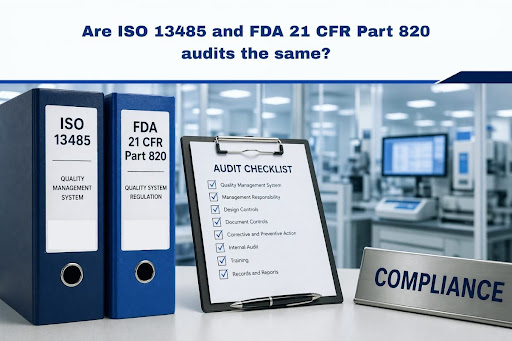
ISO 13485 is an internationally recognized standard developed by the International Organization for Standardization for quality management systems in the medical device industry. It defines how companies should design, manufacture, and manage medical devices to ensure safety, consistency, and regulatory compliance.
Key Objectives of ISO 13485
- Ensure consistent product quality and safety
- Establish a reliable and documented Quality Management System (QMS)
- Meet regulatory requirements across multiple countries
- Improve risk management throughout the product lifecycle
What Does ISO 13485 Cover?
ISO 13485 applies to the entire lifecycle of a medical device, including:
- Design and development
- Supplier and vendor control
- Manufacturing and process control
- Storage and distribution
- Post-market surveillance and feedback
Key Features of ISO 13485
- Strong focus on risk management and risk-based thinking
- Emphasis on documentation and traceability
- Integration of Corrective and Preventive Actions (CAPA)
- Requirement for internal audits and management reviews
How ISO 13485 Audits Work
- Conducted by independent certification bodies (not government agencies)
- Usually planned and scheduled in advance
- Includes:
- Initial certification audit
- Annual surveillance audits
- Recertification every 3 years
In short, ISO 13485 helps companies build a strong system, ensuring quality is not accidental but built into every process.
What is FDA 21 CFR Part 820?
FDA 21 CFR Part 820, also known as the Quality System Regulation (QSR), defines the legal quality system requirements for medical device manufacturers in the United States. It is enforced by the U.S. Food and Drug Administration and is mandatory for any company selling medical devices in the U.S.
When comparing FDA inspection vs ISO audit, this regulation represents the enforcement side of medical device compliance, ensuring companies meet strict legal standards.
Key Objectives of FDA 21 CFR Part 820
- Ensure medical devices are safe and effective
- Enforce compliance with U.S. regulatory laws
- Protect public health through strict oversight
- Hold manufacturers accountable for quality and performance
What Does FDA 820 Cover?
The regulation governs the entire quality system, including:
- Design controls and validation
- Production and process controls
- Complaint handling and reporting
- Corrective and Preventive Actions (CAPA)
- Labeling and packaging controls
- Recordkeeping and documentation
Key Features of FDA Inspections
- Conducted by FDA investigators, not third parties
- Often unannounced or risk-based
- Focused on compliance and enforcement
- Triggered by routine checks, complaints, or prior issues
Possible Outcomes
- No Action Indicated (NAI) – compliant
- Voluntary Action Indicated (VAI) – minor issues
- Official Action Indicated (OAI) – serious violations
Inspectors may also issue Form 483 observations, warning letters, or enforce recalls and import restrictions.
In short, FDA 21 CFR Part 820 ensures you meet medical device compliance in the USA, not just global quality standards.
Key Differences Between FDA QMSR and ISO 13485
| Aspect | ISO 13485 Audit | FDA 21 CFR Part 820 Audit |
|---|---|---|
| Purpose | Certification of Quality Management System | Enforcement of U.S. regulatory compliance |
| Authority | International Organization for Standardization (via certification bodies) | U.S. Food and Drug Administration |
| Audit Type | Certification audit | Regulatory inspection |
| Who Conducts It | Third-party certification bodies | FDA investigators |
| Audit Approach | Process-oriented, collaborative | Investigative, compliance-driven |
| Scheduling | Planned and scheduled | Often unannounced or risk-based |
| Frequency | Annual surveillance + 3-year recertification | No fixed schedule (risk-based) |
| Legal Status | Voluntary (market-driven) | Mandatory (legal requirement) |
| Focus Area | System effectiveness and quality processes | Legal compliance and violation detection |
| Documentation Scope | Structured QMS documentation | Strict regulatory records required |
| Regulatory Records | General documentation required | Specific records required (DMR, DHR, DHF) |
| Definitions | Standard ISO terminology | Additional FDA-specific definitions (e.g., Component, Finished Device, Remanufacturer) |
| Traceability (Critical Devices) | Standard traceability requirements | Enhanced traceability for life-sustaining and life-supporting devices |
| Flexibility | More flexible and guidance-based | Strict, rule-based, and enforceable |
| Outcome of Audit | Certification granted, maintained, or suspended | Form 483, warning letters, recalls, or penalties |
| Business Impact | Supports global market access | Determines legal ability to operate in the U.S. |
Key Similarities Between ISO 13485 and FDA 21 CFR Part 820
Despite their differences, ISO 13485 and FDA 21 CFR Part 820 are now closely aligned, especially after the introduction of QMSR. In fact, ISO 13485:2016 now serves as the foundation for U.S. medical device quality regulations. Key areas of overlap include:
Goal
Both share the same fundamental goal of ensuring medical devices are safe, effective, and consistently meet regulatory and quality requirements.
Structure
Both now rely on the same Quality Management System (QMS) framework
Design controls
Both require structured processes for design planning, verification, validation, and change management
CAPA (Corrective and Preventive Actions)
A critical component in both systems, with strong emphasis on identifying root causes and implementing effective fixes
Risk management
Integrated across the entire product lifecycle, from development to post-market monitoring
Document control and traceability
Both require detailed, well-controlled documentation to ensure full product traceability
Supplier management
Companies must evaluate, qualify, and monitor suppliers to maintain product quality
Internal audits and management responsibility
Regular audits and leadership oversight are required to ensure the system is effective and continuously improving
Which One Should You Prioritize?
The right approach depends on your target market and growth strategy.
If You’re a Global Company
- Start with ISO 13485 to build a strong, internationally accepted QMS
- Then align your system with FDA requirements for U.S. market entry
This approach gives you flexibility and smoother expansion across multiple regions.
If You’re Targeting the U.S. Market
- FDA compliance is mandatory and should be your priority
- ISO 13485 is still highly recommended to strengthen your system and credibility
In practice, most successful companies implement both together rather than choosing one over the other.
Future Outlook: Convergence of Standards
The gap between ISO 13485 and FDA 21 CFR Part 820 is steadily narrowing.
With the QMSR initiative introduced by the U.S. Food and Drug Administration:
- ISO 13485 is becoming more central to regulatory compliance
- Quality and compliance processes are becoming more unified
- Redundancy in global compliance is being reduced
For a deeper understanding of supplier audit, check out our detailed guide on FDA 21 CFR Part 820 supplier controls requirements.
How to Prepare for ISO 13485 and FDA Inspections
Preparing for ISO and FDA audits requires more than just documentation. You need a system that works in practice, not just on paper.
1. Build a Unified Quality Management System
Instead of managing ISO and FDA separately, create a single integrated QMS that meets both requirements.
- Use ISO 13485 as your foundation
- Add FDA-specific elements like UDI, labeling, and regulatory reporting
- Ensure consistency across all processes
This reduces duplication and simplifies compliance.
2. Conduct Regular Internal Audits
Internal audits help you stay audit-ready at all times.
- Identify gaps before external audits
- Test whether procedures are actually followed
- Prepare teams for real audit scenarios
Treat internal audits like real inspections, not just a formality.
3. Strengthen Documentation
Documentation is critical for both ISO and FDA.
Focus on maintaining:
- Design History Files (DHF)
- Device Master Records (DMR)
- CAPA logs
- Complaint handling records
- Training records
If it’s not documented, it doesn’t exist, especially during FDA inspections.
4. Train Your Team
Your team plays a major role during audits.
- Ensure employees understand SOPs
- Train them on audit behavior and responses
- Make sure they can explain their processes confidently
Auditors assess both documents and people.
5. Run Mock FDA Inspections
Simulating FDA inspections can significantly improve readiness.
- Practice unannounced audit scenarios
- Identify weak areas under pressure
- Improve response time and accuracy
This is one of the most effective ways to reduce risk.
6. Focus on High-Risk Areas
Certain areas are commonly targeted in audits:
- CAPA systems
- Complaint handling
- Design controls
- Supplier management
To understand how supplier evaluations are handled under ISO standards, explore our guide on ISO 13485 Supplier Audit requirements for Medical Device Companies.
Expert Insight: Where Most Companies Fail in Real Audits
Many medical device companies pass ISO audits but struggle during FDA inspections. The issue is rarely the system itself, but how it is implemented in practice.
In 2024, the FDA issued 47 warning letters to medical device companies—a 96% increase from 24 in 2023, showing a sharp rise in regulatory enforcement.
Here’s where most companies fail:
Execution gaps between ISO and FDA expectations
Companies build systems for certification but fail to meet the real-time compliance required during FDA inspections.
CAPA exists on paper, not in practice
Corrective and Preventive Actions are documented, but root causes are weak, actions are not verified, or follow-ups are missing.
Documentation is not audit-ready
Records may exist, but they are incomplete, outdated, or not easily traceable during an inspection.
Lack of real-time compliance
Teams prepare for scheduled ISO audits but are not ready for unannounced FDA inspections.
Disconnect between teams and processes
Employees cannot clearly explain procedures, creating red flags during auditor interviews.
Key Takeaway
Passing an ISO audit shows your system is designed well. Passing an FDA inspection proves your system actually works under real conditions. This gap between theory and execution is where most compliance failures happen.
Ensure Compliance with Customised Supplier Audits by AMREP Mexico
ISO 13485 and FDA 21 CFR Part 820 audits are not the same, but they are now more aligned than ever. Companies that understand both and implement a unified approach are better positioned to reduce risk, pass audits confidently, and scale across international markets.
AMREP Mexico offers customised supplier audits for medical device companies tailored to ISO 13485 and FDA requirements, helping you identify risks, verify quality systems, and ensure your suppliers meet regulatory expectations.
Get in touch with AMREP Mexico to identify supplier risks early, ensure audit readiness, and avoid costly FDA compliance failures.