How to Conduct an ESG Audit: Methods, Checklist & Best Practices
An Environmental, Social, and Governance (ESG) audit systematically reviews a company’s policies, controls, and performance against recognized frameworks such as GRI, SASB, and TCFD. The process includes defining scope, validating data, engaging stakeholders, and identifying gaps in sustainability metrics. According to the Governance & Accountability Institute, over 90% of S&P 500 companies published ESG reports in 2020, compared to just 20% in 2011. Structured ESG audits help organizations strengthen compliance, reduce risk exposure, and build long-term stakeholder trust. This guide explains the audit process, key methods, and a practical checklist to identify gaps, manage risks, and strengthen sustainability performance.
What Is an ESG Audit?
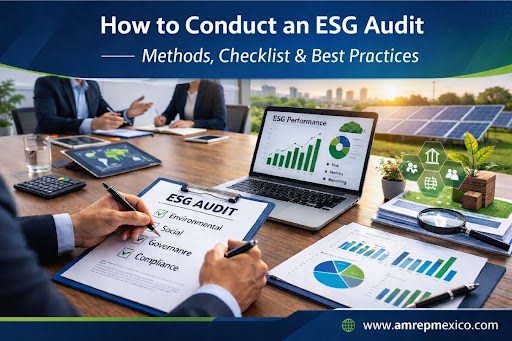
An ESG audit is a systematic evaluation of an organization’s performance in three core areas:
- Environmental – Climate impact, resource use, waste, biodiversity
- Social – Labor practices, diversity, community impact, human rights
- Governance – Ethics, compliance, transparency, board structure
Unlike traditional financial audits, ESG audits assess both quantitative metrics (emissions, injury rates) and qualitative practices (policies, oversight structures).
Methods for ESG Audits
An effective ESG audit relies on structured methods to verify data, assess risk, and evaluate whether ESG commitments are properly implemented. Below are the core methods used in comprehensive ESG audits.
1. Data Collection and Validation
Accurate, traceable data is essential. Auditors review emissions (Scope 1–3), energy and waste records, HR metrics, safety reports, governance documents, and supplier audits. Validation includes recalculating figures, sampling data, and testing internal controls to reduce errors and greenwashing risk.
2. Materiality Assessment
A materiality assessment prioritizes ESG issues with the greatest financial and reputational impact. It involves identifying key topics, engaging stakeholders, and ranking risks in a materiality matrix to focus on high-impact areas.
3. Stakeholder Engagement
Interviews with leadership, employees, and suppliers help assess how ESG policies operate in practice. This provides insight beyond written documentation.
4. Risk-Based Approach
Audits should prioritize high-risk areas such as carbon-intensive operations, vulnerable supply chains, or regulated markets. Risk scoring helps allocate audit resources effectively.
How to conduct ESG Audit- Step-by-Step Process
Below is a practical step-by-step framework organizations can follow to conduct a comprehensive ESG audit.
Step 1: Define Scope and Objectives
Every ESG audit begins with clearly defining what will be reviewed and why.
Key Actions:
- Identify applicable frameworks (e.g., GRI, SASB, TCFD, ISO standards)
- Determine business units, subsidiaries, and geographies included
- Define reporting boundaries (operational control vs. financial control)
- Clarify regulatory requirements
- Establish audit timeline and resources
Deliverable:
ESG Audit Charter outlining scope, objectives, responsibilities, and reporting structure
A well-defined scope prevents audit inefficiencies and ensures alignment with stakeholder expectations. Research from McKinsey shows that ESG risk management is a growing priority for executive leadership, particularly in areas such as climate exposure and supply chain transparency.
Step 2: Conduct a Materiality Assessment
Materiality determines which ESG topics are most significant to the organization and its stakeholders.
Key Actions:
- Identify a broad list of ESG topics
- Engage stakeholders through surveys or interviews
- Assess financial impact and reputational risk
- Rank and prioritize ESG risks
- Develop a materiality matrix
Deliverable:
Documented materiality matrix and prioritized ESG risk register
This ensures the audit focuses on high-impact issues rather than low-risk disclosures.
Step 3: Develop an Audit Plan
Once material risks are identified, develop a structured audit plan.
Key Actions:
- Define audit procedures for each ESG pillar
- Assign responsibilities to audit team members
- Determine sampling methods
- Establish documentation requirements
- Schedule interviews and site visits
The audit plan should incorporate a risk-based approach, allocating more time to high-risk areas such as carbon-intensive facilities or high-risk supply chains.
Step 4: Perform Fieldwork
This phase involves executing the audit procedures.
Activities Include:
- Reviewing policies and procedures
- Verifying ESG data calculations
- Testing internal controls
- Conducting stakeholder interviews
- Inspecting facilities (if applicable)
- Reviewing supplier compliance documentation
Auditors should gather sufficient evidence to support all conclusions. Data must be traceable to source documentation.
Step 5: Analyze Findings and Identify Gaps
After data collection, analyze findings to determine compliance levels and improvement opportunities.
Key Tasks:
- Compare performance against frameworks and benchmarks
- Identify inconsistencies or data gaps
- Assess control effectiveness
- Risk-rate findings (High / Medium / Low)
Gap analysis should highlight:
- Missing disclosures
- Weak governance controls
- Inaccurate or incomplete emissions data
- Supply chain oversight deficiencies
Step 6: Prepare the ESG Audit Report
The ESG audit report should be clear, objective, and actionable.
Recommended Structure:
- Executive Summary
- Scope and Methodology
- Findings by ESG Pillar
- Risk Assessment
- Benchmark Comparison
- Corrective Action Recommendations
Reports should focus on measurable findings supported by evidence.
Step 7: Develop and Implement Action Plans
An audit only creates value if findings lead to improvement.
Key Actions:
- Assign ownership for corrective measures
- Set measurable KPIs
- Establish timelines
- Integrate ESG improvements into enterprise risk management (ERM)
- Monitor progress through periodic reviews
Continuous monitoring ensures long-term ESG resilience.
Step 8: Ongoing Monitoring and Assurance
ESG audits should not be a one-time exercise. Ongoing monitoring strengthens governance and credibility.
Best Practices:
- Annual or biannual ESG audits
- Third-party assurance for high-risk disclosures
- Regular board-level ESG oversight
- Continuous ESG data automation and system upgrades
Complete ESG Audit Checklist
Below is a detailed breakdown of audit areas under the Environmental (E), Social (S), and Governance (G) pillars.
1. Environmental (E) Audit Checklist
The environmental pillar evaluates a company’s impact on climate, natural resources, and ecological systems. Given growing regulatory pressure and climate-related financial risks, this area often requires deep technical review.
A. Greenhouse Gas (GHG) Emissions
Greenhouse gas emissions are central to environmental audits and climate disclosures.
Audit Questions:
- Are Scope 1 (direct) emissions calculated accurately?
- Are Scope 2 (purchased electricity) emissions verified?
- Has Scope 3 (value chain) emissions mapping been conducted?
- Are emission factors documented and consistent with recognized protocols?
- Are reduction targets science-based and time-bound?
- Is there third-party verification of emissions data?
Evidence to Review:
- Fuel purchase records
- Utility invoices
- Emissions calculation spreadsheets
- Carbon accounting software outputs
- Climate strategy documentation
Scope 3 emissions often represent the largest data gap and should be examined carefully.
B. Energy Management
Energy consumption and efficiency measures are key indicators of operational sustainability.
Audit Questions:
- Is total energy consumption tracked monthly or annually?
- Is energy intensity (energy per unit of production or revenue) calculated?
- What percentage of energy comes from renewable sources?
- Are energy efficiency programs implemented and monitored?
- Are capital investments aligned with decarbonization goals?
Cross-verify reported figures with utility records and facility-level data.
C. Waste & Water Management
Resource efficiency is increasingly scrutinized by regulators and investors.
Audit Questions:
- Are waste streams categorized (hazardous vs. non-hazardous)?
- Is the recycling rate tracked and disclosed?
- Are hazardous waste disposal procedures compliant?
- Is water withdrawal measured and reported?
- Are facilities located in water-stressed regions identified?
Site inspections and environmental permits should be reviewed.
D. Environmental Compliance
Compliance failures can lead to financial penalties and reputational damage.
Audit Questions:
- Are environmental permits current?
- Have there been environmental fines or violations?
- Are environmental incidents documented and investigated?
- Are environmental impact assessments conducted for new projects?
- Is the company certified under ISO 14001 (if applicable)?
Non-compliance issues should be classified and risk-rated.
2. Social (S) Audit Checklist
The social pillar evaluates how the organization manages relationships with employees, suppliers, customers, and communities.
A. Labor Practices & Human Rights
Audit Questions:
- Are labor policies compliant with local and international standards?
- Are anti-child labor and forced labor policies enforced?
- Are working hours and wage practices compliant?
- Is there a grievance mechanism available to workers?
- Is human rights due diligence conducted in high-risk regions?
Auditors should review employment contracts, worker interviews, and supplier audits.
B. Health & Safety
Workplace safety is a critical operational and reputational factor.
Audit Questions:
- Are occupational health and safety policies documented?
- Are safety training programs regularly conducted?
- Is the lost-time injury frequency rate (LTIFR) tracked?
- Are incidents investigated with corrective actions implemented?
- Are emergency response procedures tested?
Cross-check reported metrics against official safety logs.
C. Diversity, Equity & Inclusion (DEI)
Investors increasingly evaluate workforce diversity and inclusion metrics.
Audit Questions:
- Is workforce demographic data collected and disclosed?
- Is the gender pay gap analyzed?
- Are inclusive hiring and promotion policies implemented?
- Is DEI training provided?
- Is board-level diversity disclosed?
Validate that public disclosures align with internal HR records.
D. Supply Chain Management
Supply chain transparency is a major ESG risk area.
Audit Questions:
- Is there a supplier code of conduct?
- Are suppliers audited for labor and environmental compliance?
- Are high-risk suppliers identified and monitored?
- Is there traceability for critical raw materials?
- Are corrective action plans enforced for non-compliant suppliers?
High-risk geographies and industries require deeper review.
3. Governance (G) Audit Checklist
Global governance principles promoted by organizations such as the OECD emphasize transparency, accountability, and documented decision-making in sustainability reporting.
A. Board Structure & Composition
Audit Questions:
- Is the majority of the board independent?
- Is there a dedicated ESG or sustainability committee?
- Is board diversity tracked and disclosed?
- Are ESG risks regularly discussed at board meetings?
Review governance charters and meeting minutes.
B. Business Ethics & Compliance
Ethical governance is essential for long-term sustainability.
Audit Questions:
- Are anti-bribery and anti-corruption policies implemented?
- Is there a whistleblower reporting mechanism?
- Are ethics training programs mandatory?
- Are investigations documented and resolved?
Assess effectiveness, not just policy existence.
C. Executive Compensation
Alignment between executive incentives and ESG goals demonstrates accountability.
Audit Questions:
- Are ESG metrics included in executive bonus structures?
- Are compensation policies transparent?
- Are long-term incentives linked to sustainability targets?
Review compensation committee disclosures.
D. Data Governance & Internal Controls
ESG data integrity is critical to credibility.
Audit Questions:
- Is there a formal ESG reporting control framework?
- Are responsibilities clearly assigned?
- Is internal audit involved in ESG review?
- Is third-party assurance obtained?
Strong controls reduce greenwashing risk and improve investor trust.
Common ESG Audit Challenges
Despite growing maturity in sustainability reporting, ESG audits still face several practical challenges, including:
- 1. Inconsistent Data
ESG information is frequently dispersed across departments, leading to incomplete or inconsistent data—particularly in complex areas like Scope 3 emissions and supplier reporting. - 2. Weak Internal Controls
Many companies lack formal internal control structures for ESG reporting, increasing the risk of inaccuracies and unsupported disclosures. - 3. Limited Supply Chain Visibility
Obtaining accurate ESG data from suppliers, especially in high-risk or international regions, remains a significant challenge. - 4. Regulatory Changes
Expanding and evolving ESG regulations require continuous monitoring and regular updates to reporting processes. - 5. Greenwashing Risk
Unverified or exaggerated sustainability claims can result in reputational damage and regulatory scrutiny.
Learn how often to audit suppliers in our risk-based supplier audit frequency guide.
Best Practices for Effective ESG Audits
To ensure ESG audits deliver meaningful insights and long-term value, organizations should adopt structured, proactive, and governance-driven practices, such as:
- 1. Integrate ESG with Risk Management
Align ESG risks with enterprise risk management to treat sustainability as a strategic priority. - 2. Follow Recognized Frameworks
Benchmark against standards like the Global Reporting Initiative, Sustainability Accounting Standards Board, and Task Force on Climate-related Financial Disclosures for consistency and credibility. - 3. Strengthen Internal Controls
Assign clear ownership of ESG data and formalize reporting processes to reduce errors and greenwashing risks. - 4. Centralize ESG Data
Use digital systems to improve data accuracy, traceability, and audit readiness. - 5. Ensure Ongoing Monitoring and Assurance
Conduct regular reviews and consider third-party assurance to enhance transparency and stakeholder trust.
For a detailed overview of ethical trade audits, read our guide on SMETA Audit to understand the requirements and preparation steps.
Partner with AMREP Mexico for ESG Audit Excellence
A disciplined ESG audit strengthens regulatory compliance, mitigates operational risk, and reinforces investor confidence. However, effective execution requires technical expertise, structured methodology, and alignment with evolving global standards.
AMREP Mexico provides specialized ESG, supplier, and factory audit services designed to support transparent reporting and sustainable growth.
Connect with AMREP Mexico to implement a structured ESG audit framework that delivers measurable compliance and long-term resilience.