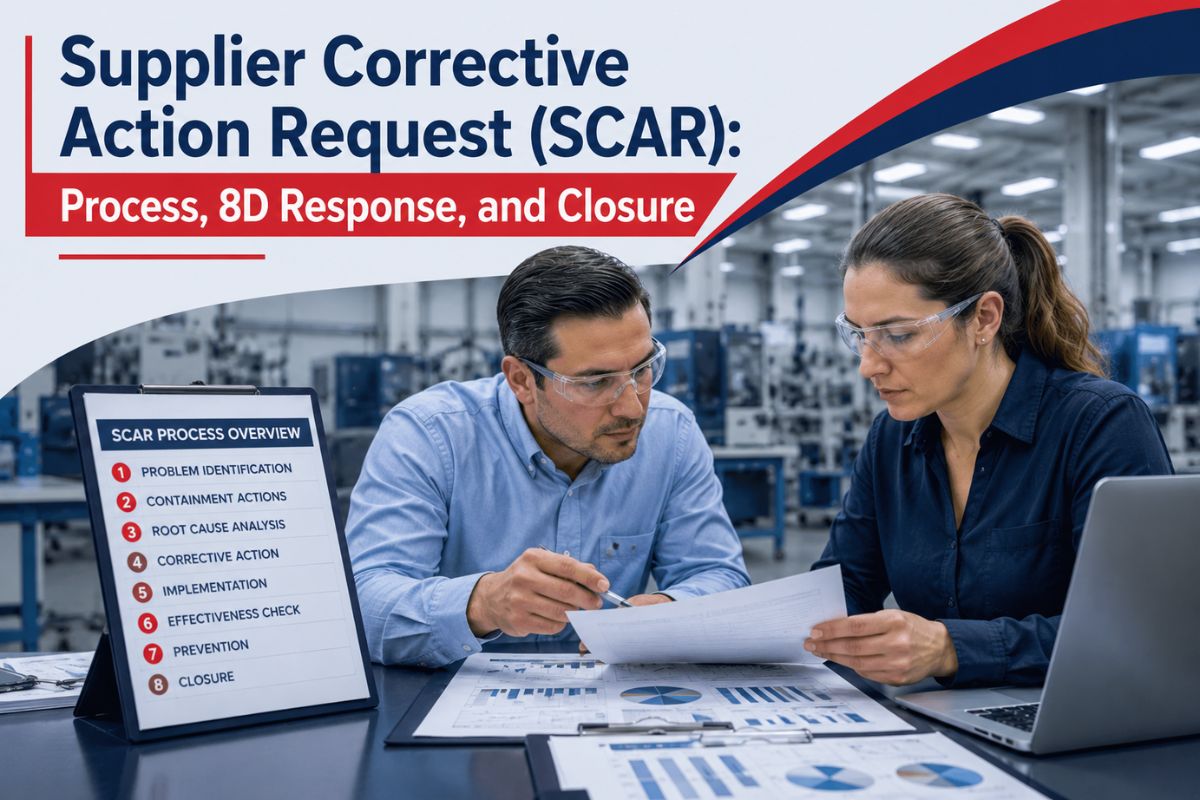
Supplier Corrective Action Request (SCAR): Process, 8D Response, and Closure
A Supplier Corrective Action Request (SCAR) is a formal process that requires a supplier to investigate a quality problem, identify its root cause, implement corrective action, and prove the issue will not recur. According to the American Society for Quality (ASQ), the SCAR process includes containment, root cause and corrective action, implementation, effectiveness, and closure.
Many organizations use an 8D response to structure the investigation. ASQ describes 8D as a systematic approach that addresses problem definition, containment, root cause, corrective action, and prevention.
But completing an 8D does not automatically mean a SCAR is ready for closure. The real test is whether the supplier provides evidence that the corrective action works and prevents recurrence.
This guide covers the SCAR process, 8D response, root cause evaluation, corrective action, effectiveness verification, and closure.
What Is a Supplier Corrective Action Request (SCAR)?
A Supplier Corrective Action Request (SCAR) is a formal request for a supplier to investigate and correct a quality problem.
A company may issue a SCAR when a supplier provides:
- Nonconforming products
- Defective materials
- Recurring quality issues
- Products outside specifications
- Material that reaches production or customers
A SCAR goes beyond replacing defective material. It requires the supplier to determine why the problem occurred and how to prevent it from recurring.
For example, replacing components with incorrect dimensions fixes the immediate issue. A SCAR investigation must determine why the dimensions were incorrect and what will prevent the same failure from happening again.
When Should a SCAR Be Issued?
It may be appropriate when:
- The defect has significant customer impact.
- The same problem keeps recurring.
- Defective material reaches production.
- Incoming inspection identifies a serious nonconformance.
- A supplier fails to control a known process risk.
- A supplier quality issue causes production disruption.
Minor, isolated issues may only require correction. Recurring or high-risk problems generally require a more structured corrective action.
SCAR Is Not the Same as an 8D
A SCAR is the formal request for supplier corrective action.
An 8D is a structured problem-solving method that the supplier can use to investigate and respond to the SCAR.
The relationship is simple:
Nonconformance → SCAR → 8D → Corrective Action → Verification → Closure
SCAR, NCR, CAPA, and Corrective Action
These terms serve different purposes:
- NCR/NCMR: Records the nonconformance.
- SCAR: Requests corrective action from the supplier.
- 8D: Structures the problem investigation.
- Corrective Action: Addresses the verified cause.
- CAPA: Manages broader corrective and preventive actions.
Using the right process helps prevent a supplier issue from being treated as a simple defect replacement instead of a recurring quality problem.
The Supplier Corrective Action Request Process
A SCAR should move from problem identification to verified resolution. Each step should produce enough evidence for the next decision.
Step 1: Identify and Document the Nonconformance
Start with measurable facts. Record:
- Part or product number
- Supplier name
- Lot or batch number
- Quantity affected
- Required specification
- Actual result
- Defect description
- Inspection evidence
Avoid guessing the cause at this stage. The initial step should clearly describe what failed, not why it failed.
Step 2: Assess Severity and Risk
The severity of the issue should influence the required response. Higher risk may require faster containment, tighter controls, shorter response deadlines, and stronger escalation.
Consider:
- Customer and production impact
- Safety or regulatory risk
- Quantity affected
- Recurrence history
- Risk of further escape
Step 3: Implement Immediate Containment
Containment protects the customer while the supplier investigates the cause.
Typical actions include:
- Quarantining affected material
- Stopping shipment
- Sorting inventory
- Inspecting available stock
- Increasing inspection
- Identifying affected lots
Containment controls the current problem. Corrective action prevents its recurrence.
Step 4: Issue the SCAR
The SCAR should clearly communicate:
- The nonconformance
- Supporting evidence
- Required containment
- Response deadline
- Required corrective action
- Required documentation
SCAR deadlines vary by customer and severity. For example, Graco requires containment within 24 hours and sets implementation targets based on priority, while Creation Technologies specifies separate targets for containment, root cause and corrective action planning, and final effectiveness evidence. These examples show why suppliers should follow the specific requirements defined by the customer rather than assume one universal SCAR timeline.
Step 5: Supplier Acknowledgment and Team Assignment
The supplier should acknowledge the SCAR and assign responsibility for the investigation.
The team should include people with relevant knowledge of:
- Quality
- Production
- Engineering
- Manufacturing processes
A clear owner keeps the investigation moving and establishes accountability.
Step 6: Investigate the Root Cause
The supplier investigates why the nonconformance occurred using appropriate evidence and problem-solving methods.
Common tools include:
- 5 Whys
- Fishbone analysis
- Process mapping
- Pareto analysis
- PFMEA review
The supplier should document the investigation findings and identify the causes that require corrective action.
Step 7: Develop Permanent Corrective Actions
Based on the investigation, the supplier develops actions to address the identified causes.
Depending on the problem, actions may include:
- Process changes
- Tooling changes
- Parameter controls
- Error proofing
- Improved inspection
- Equipment controls
- Procedure changes
The supplier should document the proposed actions, responsible owners, and implementation requirements.
Step 8: Implement the Corrective Action
The supplier implements the approved corrective actions and provides evidence of completion.
Evidence may include:
- Revised work instructions
- Updated control plans
- Process records
- Inspection results
- Training records
- Photos
- Test results
Step 9: Verify Effectiveness
The supplier verifies whether the implemented corrective action achieves the expected result.
The response should document:
- What was measured
- How it was measured
- Acceptance criteria
- Verification period
- Supporting results
The customer can then review this evidence to determine whether the corrective action is effective.
Step 10: Close, Reopen, or Escalate the SCAR
After reviewing the supplier's response and supporting evidence, the customer determines the next action.
The SCAR may be:
- Closed when requirements and effectiveness criteria are met.
- Reopened when the response or results are insufficient.
- Escalated when the supplier fails to resolve the issue or the risk remains unacceptable.
This keeps the supplier corrective action request process focused on what happens, while the later sections explain how to judge the quality of the supplier's response.
What Is an 8D Response to a SCAR?
An 8D response gives the supplier a structured format for documenting its investigation and corrective actions.
Each discipline should show what the supplier investigated, what it changed, and what evidence it can provide. The customer then reviews that response to determine whether the investigation and corrective actions meet the SCAR requirements.
D1: Establish the Problem Solving Team
Identify the people responsible for investigating the problem.
The team should include relevant expertise from areas such as:
- Quality
- Engineering
- Production
- Manufacturing
Response should include: team members, roles, and relevant expertise.
D2: Define the Problem
Describe the problem using measurable facts.
The response should explain:
- What failed
- Where it occurred
- When it occurred
- How many units were affected
- What requirement was not met
- What evidence confirms the failure
Weak: Parts had dimensional issues.
Stronger: 37 of 500 inspected parts exceeded the specified diameter tolerance.
D3: Implement Interim Containment
Explain how the supplier has protected the customer while investigating the problem.
The response should identify:
- Affected lots
- Contained material
- Inventory checked
- Inspection performed
- Controls applied to future shipments
Containment should prevent additional defective material from reaching the customer.
D4: Identify Root Cause and Escape Cause
The supplier should identify:
Occurrence cause: Why did the defect happen?
Escape cause: Why did the supplier's controls fail to detect it?
The 8D should document the investigation, supporting evidence, and identified causes.
The customer then evaluates whether the stated causes are supported by evidence and whether they adequately explain both the defect and its escape.
D5: Select Permanent Corrective Actions
The supplier should document the corrective actions selected to address the identified causes.
The response should show:
- Proposed action
- Responsible owner
- Implementation requirements
- Expected result
The customer evaluates whether each action has a clear connection to the identified cause.
D6: Implement and Validate Corrective Actions
The supplier should document what was changed and provide evidence of implementation.
This may include:
- Revised procedures
- Updated control plans
- Process records
- Inspection results
- Validation results
The customer reviews this evidence to confirm that the corrective action was actually implemented and validated.
D7: Prevent Recurrence
The supplier should review whether the same failure could affect similar products, processes, or locations.
Relevant documents may include:
- PFMEA
- Control plans
- Work instructions
- Inspection methods
The customer evaluates whether the supplier has considered similar risks rather than limiting the response to the affected batch.
D8: Verify and Close
The supplier should provide the final effectiveness results, updated documentation, and required approvals.
The customer then determines whether the evidence supports SCAR closure.
Submitting D8 completes the supplier's response. Customer approval completes the SCAR.
For a deeper look at how this methodology works, explore our guide to the Eight Disciplines of Problem Solving methodology*. *
How to Evaluate an 8D Response
The supplier's 8D explains what was investigated and what was changed. The customer's review determines whether that response is sufficient.
Before accepting an 8D, evaluate five areas.
- Is the Root Cause Proven?
Ask: What evidence proves this is the root cause?
"Operator error" alone rarely explains why the process allowed the error.
- Is the Escape Cause Identified?
The supplier should explain both:
Occurrence: Why did the defect happen?
Escape: Why did the inspection or control system miss it?
- Does the Corrective Action Match the Cause?
The action should directly address the verified cause.
If uncontrolled machine settings caused the defect, retraining alone may not be enough. The process may also need parameter controls or verification.
- Were Similar Risks Reviewed?
Check whether the same failure could affect:
- Similar products
- Similar processes
- Other machines
- Other locations
- Is Effectiveness Proven?
Look for post-implementation evidence such as:
- Inspection results
- Production data
- SPC records
- Audit results
- Subsequent lot performance
"No further complaints" is not the same as measurable evidence of effectiveness.
Cause vs. Contributing Factor vs. Root Cause
A strong Supplier Corrective Action Request response must distinguish between what happened and why the process allowed it to happen.
Consider a machining defect where a hole exceeds the required diameter.
- Immediate cause: The machine used an incorrect parameter.
- Contributing factor: Operators could change the parameter without verification.
- Root cause: The process had no effective control over parameter changes.
This distinction matters because each level leads to a different response.
If the supplier only corrects the immediate cause, the same failure can return. A strong corrective action addresses the root cause that allowed the problem to occur.
Why "Operator Error" Is Often an Incomplete Root Cause
"Operator error" may describe what happened, but it does not always explain why the process allowed the error to occur.
Before accepting it as the root cause, ask:
- Was the work instruction clear?
- Was the operator properly trained?
- Could the process prevent the mistake?
- Was verification required?
- Could the equipment detect the error?
If the process depends entirely on an operator remembering the correct setting, the supplier may need a stronger control.
A useful hierarchy is:
Eliminate → Automate → Error proof → Detect → Train
Training can help, but it should not become the only control when the process itself allows the failure.
The Corrective Action Traceability Test
A corrective action should have a clear connection to the verified root cause.
Use this simple chain:
Root Cause → Corrective Action → Implementation Evidence → Effectiveness Result
For example:
- Root Cause: Tool wear was not controlled.
- Corrective Action: Introduce defined tool life limits and monitoring.
- Implementation Evidence: Tool monitoring was added, and the control plan was updated.
- Effectiveness Result: Subsequent production remained within specification.
If the corrective action does not clearly address the identified cause, the SCAR should not move toward closure until the response is strengthened.
How to Judge the Strength of a Corrective Action
Not every corrective action provides the same level of control. Review the action based on how directly it addresses the failure.
Level 1: Symptom Correction
The supplier replaces or repairs defective material.
Result: The immediate problem is fixed, but the cause remains.
Level 2: Immediate Cause Correction
The supplier adjusts the process that produced the defect.
Result: Better control, but recurrence may still be possible.
Level 3: Root Cause Elimination
The supplier removes the underlying process failure.
Result: Stronger protection against recurrence.
Level 4: Systemic Prevention
The supplier checks similar products and processes for the same risk.
Result: The corrective action protects more than the affected batch.
Level 5: Verified Effectiveness
Production or quality data confirms that the corrective action continues to work.
Result: The Supplier Corrective Action Request has evidence to support closure.
What Evidence Should Support a SCAR Response?
A supplier should support its conclusions with evidence rather than statements.
Problem Evidence
- Inspection results
- Measurements
- Photos
- Test reports
Root Cause Evidence
- Process data
- Machine records
- Investigation findings
- PFMEA analysis
Implementation Evidence
- Revised work instructions
- Updated control plans
- Process records
- Training records
Effectiveness Evidence
- Subsequent lot results
- SPC data
- Capability results
- Audit findings
- Inspection records
The evidence should show a clear connection between the problem, root cause, corrective action, and final result.
How Much Evidence Is Enough to Close a SCAR?
There is no single amount of evidence that applies to every SCAR. The verification requirement should match the risk and severity of the problem.
Consider:
- Defect severity
- Customer impact
- Recurrence history
- Production frequency
- Process stability
- Corrective action complexity
Before verification begins, define three things:
- Metric: What will be measured?
- Acceptance criteria: What result is acceptable?
- Verification period: How long will the result be monitored?
For example, instead of saying "continue monitoring," define a measurable requirement such as zero recurrence during the agreed verification period.
When Is a SCAR Truly Closed?
It should not close simply because the supplier submitted the final 8D. Think of closure in three stages:
Administrative Closure
The supplier has completed the required documentation.
Technical Closure
The corrective action has been implemented and addresses the identified cause.
Effective Closure
Evidence confirms that the corrective action works and the problem has not recurred during the defined verification period.
Before closing, confirm:
- Root cause is verified.
- Escape cause is addressed.
- Corrective action is implemented.
- Effectiveness criteria are met.
- Relevant documents are updated.
- Similar risks have been reviewed.
- Final approval is recorded.
The goal of SCAR closure is not a completed form. It is verified resolution.
When Should a Closed SCAR Be Reopened?
It should be reopened when new evidence shows that the corrective action did not fully resolve the problem.
Common triggers include:
- The same defect occurs again.
- Effectiveness results fail.
- The original root cause proves incorrect.
- The corrective action was not consistently implemented.
- A similar failure appears in another product or process.
Reopening the SCAR allows the supplier to investigate the new evidence instead of treating the original closure as final.
What Happens When a Supplier's 8D Is Not Good Enough?
A supplier response may look complete but still lack sufficient evidence or a valid corrective action. In that case, the SCAR should remain open.
When supplier problems persist, a structured approach to solving supplier quality issues in Mexico can help identify underlying process weaknesses and prevent recurring defects.
Weak Root Cause
Ask the supplier to provide evidence supporting the proposed cause.
Weak Corrective Action
Request an action that directly addresses the verified root cause.
Missing Evidence
Keep the SCAR open until the supplier provides the required records or results.
Failed Effectiveness
Reopen the investigation and require further corrective action.
Repeated Supplier Failure
Escalate when the supplier repeatedly fails to resolve the issue through measures such as:
- Supplier audit
- Increased inspection
- Supplier development
- Management review
- Supplier performance review
The objective is to resolve the quality issue, not simply complete the paperwork.
SCAR Review Scorecard
A simple scorecard can help quality teams evaluate an 8D consistently before approving closure.
| Evaluation Area | Review Question | Pass Condition |
|---|---|---|
| Problem | Is the failure clearly defined? | Measurable evidence |
| Containment | Is affected material controlled? | No further escape |
| Root Cause | Is the cause proven? | Supporting evidence |
| Escape Cause | Why did controls miss it? | Detection failure identified |
| Corrective Action | Does it address the cause? | Clear cause-to-action link |
| Prevention | Could it happen elsewhere? | Similar risks reviewed |
| Implementation | Was the action completed? | Records available |
| Effectiveness | Does the fix work? | Acceptance criteria met |
| Documentation | Were controls updated? | Relevant documents revised |
| Closure | Is the problem resolved? | Evidence supports closure |
This approach shifts SCAR review from checking completed fields to evaluating whether the supplier actually solved the problem.
Inspection results can provide important evidence when verifying whether a supplier's corrective action has produced consistent results. See our quality inspection checklist *for key inspection areas and criteria *
SCAR Example: Weak 8D vs. Strong 8D
Consider a supplier producing machined components with holes that exceed the specified diameter.
Weak 8D Response
Root cause: Operator error.
Corrective action: Retrain the operator.
Verification: No further complaints received.
This response does not explain why the error occurred or why the process allowed it to pass undetected.
Investigation
Further review shows that operators could change machining parameters without verification.
The inspection process also did not check the hole diameter at the required frequency.
Stronger 8D Response
Root cause: The process lacked controls for machining parameter changes.
Escape cause: The inspection process did not detect the dimensional variation before shipment.
Corrective actions:
- Restrict parameter changes.
- Add parameter verification.
- Update work instructions.
- Increase required dimensional checks.
Effectiveness: Subsequent production results confirm that the hole diameter remains within specification.
SCAR Escalation Path for Recurring Supplier Problems
A supplier issue should not remain in the same corrective action cycle when the problem keeps returning.
A practical escalation path is:
Supplier Defect → SCAR → 8D → Corrective Action → Effectiveness Review
If the problem returns:
Reopen SCAR → Supplier Audit → Increased Inspection → Supplier Development → Management Escalation
The level of escalation should depend on:
- Defect severity
- Recurrence
- Customer impact
- Supplier response
- Effectiveness of previous corrective actions
The purpose of escalation is to address persistent supplier risk before it creates larger quality or production problems.
If corrective actions continue to fail, a supplier audit can help identify weaknesses in the supplier's processes, quality controls, and operational practices.
How SCAR Fits Into the Broader Supplier Quality Process
SCAR works as part of a larger supplier quality system rather than as a standalone document.
A typical flow looks like this:
Supplier Qualification → Supplier Audit → Incoming Inspection → Nonconformance → SCAR → 8D → Corrective Action → Effectiveness Verification → Supplier Performance Review
Each stage provides information for the next.
For example, recurring Supplier Corrective Action Requests can indicate weaknesses in a supplier's process controls and may justify a supplier audit or closer performance monitoring. This helps organizations use corrective action data to make better supplier quality decisions.
SCAR is only one part of supplier quality management. A broader supplier quality management approach connects supplier evaluation, audits, quality control, and ongoing performance monitoring.
SCAR Metrics That Actually Matter
SCAR metrics should show whether suppliers resolve problems effectively, not simply how quickly they complete paperwork.
Useful metrics include:
- SCAR response time: How quickly the supplier acknowledges and responds.
- SCAR closure time: How long the complete investigation takes.
- Repeat SCAR rate: How often the same or related problem returns.
- Supplier PPM: Measures defective parts against total supplied quantity.
- Overdue SCARs: Shows unresolved corrective actions.
- First pass 8D acceptance rate: Shows how often responses meet requirements without rework.
- Corrective action effectiveness: Measures whether implemented actions actually work.
Fast closure alone does not indicate good supplier performance. A supplier that closes SCARs quickly but repeatedly produces the same defect still has an unresolved quality problem.
Frequently Asked Questions
Who is responsible for approving SCAR closure?
The customer or designated quality authority usually approves closure after reviewing the supplier's response and verification evidence. The supplier may complete the corrective action, but the receiving organization determines whether the response meets its requirements.
What happens if a supplier misses the SCAR response deadline?
The organization can request a status update, escalate the issue, or apply additional controls depending on the severity and supplier history. A missed deadline should not result in automatic closure.
Should a SCAR include a financial impact?
It can be useful when the organization tracks the cost of supplier quality problems. Costs may include sorting, rework, scrap, production downtime, returns, or additional inspection.
Can one SCAR cover multiple related defects?
Yes, when the defects share a common failure mode or root cause. Separate SCARs may be more appropriate when the issues have unrelated causes or require different corrective actions.
What happens to SCAR records after closure?
Organizations should retain SCAR records according to their quality system requirements. Historical records can help identify recurring supplier problems, support audits, and inform future supplier evaluations.
Should SCARs affect supplier ratings?
They can. Organizations may use SCAR frequency, recurrence, response quality, and closure performance as inputs to supplier scorecards and supplier development decisions.
Can a SCAR be issued for a process problem before defective material is found?
Yes. If an audit or other evidence identifies a significant supplier process weakness that could create nonconforming product, the organization may require corrective action before an actual product escape occurs.
What is the difference between a supplier correction and supplier corrective action?
A correction fixes the immediate condition, such as replacing defective parts. Corrective action addresses the root cause so the same problem does not recur.
Partner With AMREP Mexico To Turn Supplier Corrective Actions Into Better Quality Control
A SCAR should do more than document a supplier defect. It should help you move from nonconformance to verified resolution.
At AMREP Mexico, supplier quality starts with finding problems before they become costly production or customer issues. Our Supplier Quality Engineering services help companies evaluate supplier performance, investigate nonconformities, and strengthen quality controls throughout the manufacturing process.
If you need greater visibility into your suppliers and want to reduce quality risks before they reach your production line, contact AMREP Mexico to discuss your supplier quality inspection requirements.