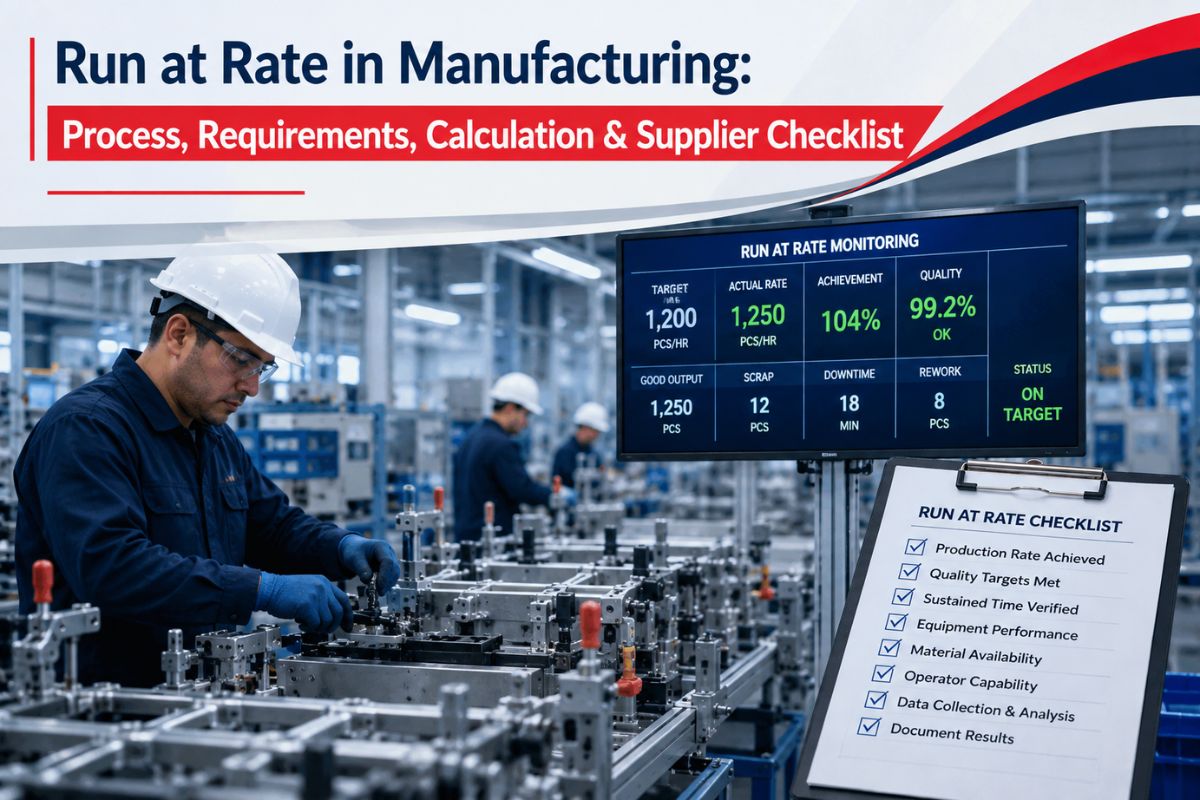
Run at Rate in Manufacturing: Process, Requirements, Calculation & Supplier Checklist
Run at Rate in Manufacturing is a controlled production test that verifies whether a supplier can meet the required output, production rate, and quality under actual operating conditions. According to General Motors (GM), Run at Rate is part of supplier capacity readiness and launch execution, alongside analysis of line rates, station performance, constraints, labor assumptions, and equipment readiness. The production line runs with actual tooling, materials, equipment, and trained operators while teams measure cycle time, good output, scrap, rework, downtime, and bottlenecks.
Unlike a theoretical capacity calculation, it provides evidence of what the production system can actually deliver before full scale production. This helps manufacturers identify capacity gaps and process risks before they affect customer deliveries.
What Is Run at Rate in Manufacturing?
Run at Rate (RAR) is a controlled production trial that verifies whether a supplier can produce the required quantity of conforming parts at the required production rate using the intended production process.
Unlike a theoretical capacity study, this production trial evaluates the manufacturing system under defined production conditions, including:
- Production equipment and tooling
- Production materials
- Trained operators
- Approved process settings
- Inspection systems
- Standard work instructions
- Actual cycle times
- Downtime and changeovers
- Scrap and rework
- Packaging and supporting operations
The key question is:
Can the complete production system consistently produce enough good parts to meet customer demand?
Customer specific requirements often define when and how the assessment must be performed. GM, for example, connects Run at Rate verification with APQP, PPAP, supplier capacity, tooling, labor, and production readiness.
Why Is Run at Rate Important?
Run at Rate in Manufacturing helps suppliers identify capacity gaps before they affect customer deliveries.
For example, a process may have a theoretical capacity of 180 pieces per hour, while the customer requires 150 good pieces per hour. The apparent margin can disappear through downtime, changeovers, reduced speed, scrap, rework, material shortages, or inspection delays.
The production trial exposes these losses before they become delivery problems.
It therefore verifies whether the supplier can:
- Produce the required quantity
- Achieve the required rate
- Maintain quality
- Use normal production resources
Run at Rate vs. Capacity Study vs. PPAP
These activities answer different questions:
| Activity | Primary Question |
|---|---|
| Capacity Study | How much can the process produce based on defined assumptions? |
| Run at Rate | Can the production system demonstrate the required output under production conditions? |
| PPAP | Can the supplier demonstrate that the product and process meet specified requirements? |
A capacity study estimates or calculates capability. The production trial demonstrates it under production conditions. PPAP provides product and process approval evidence.
Run at Rate does not replace PPAP.
Customers may connect these activities within their APQP and supplier approval process.
When Is Run at Rate Required?
The exact trigger depends on customer requirements. Common situations include:
- New product launch
- New supplier
- New production line
- New tooling or equipment
- Major process change
- Production relocation
- Significant increase in demand
- Capacity concerns
- Repeated delivery problems
- Customer specific APQP requirements
Some customer specific requirements define a volume increase as a Run at Rate trigger. For example, Merit Automotive identifies a 20% or greater increase over previously verified capability as one trigger.
There is no universal Run at Rate requirement. Always check the applicable customer specific requirements, supplier manual, APQP documentation, purchase agreement, and launch requirements.
For manufacturers working in regulated environments, a GMP audit guide for manufacturing and supplier control *can also help strengthen supplier oversight and verify that quality requirements are consistently maintained. *
Run at Rate Process: Step by Step
The Run at Rate in Manufacturing process begins by defining customer demand, production time, required output, and acceptance criteria.
1. Define the Customer Requirement
Confirm:
- Part number and revision
- Required daily or weekly volume
- Peak demand
- Available production hours
- Number of shifts
- Required production rate
- Quality requirements
- Required assessment duration
- Capacity margin, if specified
- Customer witness requirements
- Required documentation
The target must be expressed as a measurable production requirement.
2. Calculate the Required Production Rate
Use:
Required production rate = Required good quantity ÷ available production time
Example
- Customer demand: 2,400 good parts/day
- Available production time: 16 hours/day
- Required production rate: 2,400 ÷ 16 = 150 good parts/hour
Takt time
Takt time = Available production time ÷ customer demand
- 16 hours × 60 = 960 minutes
- 960 ÷ 2,400 = 0.40 minutes
Therefore:
- Takt time = 24 seconds per good part
This establishes the production benchmark.
3. Identify the Bottleneck
Calculate the capacity of each critical operation.
| Operation | Cycle Time | Theoretical Rate |
|---|---|---|
| Cutting | 18 sec | 200/hr |
| Forming | 22 sec | 164/hr |
| Welding | 28 sec | 129/hr |
| Inspection | 20 sec | 180/hr |
| Packaging | 15 sec | 240/hr |
If the required rate is 150 good parts/hour, welding is the constraint because its theoretical rate is only 129 parts/hour.
The production system is constrained by its critical bottleneck, not by the average capacity of its machines.
The supplier should address the constraint before the formal production assessment.
4. Verify Production Readiness
Before the formal trial, verify that the intended production system is ready.
If you are evaluating a new manufacturing partner, this Sourcing Checklist *provides additional guidance on assessing supplier capabilities, quality controls, and production readiness before committing to production. *
Equipment and tooling
- Production equipment installed and commissioned
- Production tooling available
- Fixtures, dies, or molds validated
- Process settings established
- Preventive maintenance completed
People and process controls
- Operators trained
- Required staffing available
- Process flow reflects the actual process
- PFMEA and control plan are current
- Work instructions are released
- Gauges are calibrated
- Measurement systems are suitable
- Reaction plans are defined
Materials and logistics
- Approved production material available
- Correct material revision confirmed
- Critical sub tier capacity understood
- Approved packaging available
- Traceability and labeling ready
5. Conduct a Pre Run
A pre run should expose problems before the customer witnesses the formal event.
Measure:
- Actual cycle time
- Hourly output
- Downtime
- Changeover time
- Scrap
- Rework
- Material interruptions
- Equipment failures
- Inspection delays
Use the results to correct issues before the formal capacity assessment.
6. Run Under Normal Production Conditions
The formal assessment should use the resources and conditions expected after launch:
- Production equipment
- Production tooling
- Production materials
- Normal operators
- Approved work instructions
- Normal inspection methods
- Approved process parameters
Avoid temporary conditions that will not exist during normal production, such as extra operators, temporary equipment, special material, excessive manual sorting, or unapproved overtime.
The purpose is to demonstrate sustainable production capacity, not a one time peak result.
7. Record Gross Output, Scrap, Rework, and Good Output
Gross production alone does not demonstrate usable capacity.
Example:
- Total produced: 2,650
- Scrap: 70
- Rework: 80
- Good parts: 2,500
Record each category separately.
Good output = Total produced − Scrap − applicable nonconforming losses
If reworked parts eventually become conforming, record them separately and follow the customer's reporting rules for acceptance.
8. Compare Actual Results With the Requirement
| Metric | Requirement | Actual | Result |
|---|---|---|---|
| Good parts/day | 2,400 | 2,500 | Meets |
| Good rate | 150/hr | 156/hr | Meets |
| Scrap | ≤2% | 2.6% | Review |
| Rework | ≤1% | 3.2% | Review |
| Changeover | ≤30 min | 34 min | Review |
| Quality | Customer spec | Within spec | Meets |
A quantity pass does not automatically mean the production assessment is satisfactory. Review the complete result against the customer's capacity, quality, and process requirements.
How to Calculate Run at Rate Capacity
Capacity calculations are central to Run at Rate in Manufacturing because they show whether demonstrated good output can meet customer demand. A basic theoretical calculation is:
Theoretical capacity = Available production time ÷ cycle time
A more realistic model accounts for production losses:
Good output = Ideal rate × available time × availability × performance × quality
Example
Assume:
- Ideal rate = 180 parts/hour
- Production time = 16 hours
- Availability = 90%
- Performance = 95%
- Quality = 98%
180 × 16 × 0.90 × 0.95 × 0.98 = 2,409 good parts/day
If customer demand is 2,400 good parts/day, the supplier technically meets the target.
But only:
2,409 − 2,400 = 9 good parts/day
remain as capacity buffer.
That is less than 0.4% above required demand, so the result deserves a risk review.
Capacity Margin: How Much Buffer Does a Supplier Have?
Formula
Capacity margin = Demonstrated good capacity − Required customer capacity
Percentage:
Capacity margin % = (Demonstrated capacity − Required capacity) ÷ Required capacity × 100
Using the example above:
(2,409 − 2,400) ÷ 2,400 × 100 = 0.375%
There is no universal Run at Rate capacity margin percentage.
The appropriate buffer depends on:
- Customer requirements
- Demand variability
- Process stability
- Downtime
- Changeovers
- Equipment reliability
- Quality performance
- Supply chain constraints
A barely passing result should therefore not automatically be treated as robust capacity.
Run at Rate and OEE: What Is the Difference?
OEE helps explain production losses, but Run at Rate is not an OEE audit.
OEE separates losses into:
- Availability: downtime and stops
- Performance: speed and cycle losses
- Quality: scrap and defects
The production assessment focuses on whether the supplier can demonstrate the customer's required good output at the required production rate.
Therefore, OEE can support capacity analysis, but it does not replace the customer's acceptance criteria.
How Long Should a Run at Rate Be?
There is no universal duration.
The customer may specify:
- Fixed hours
- A full shift
- Multiple shifts
- A production quantity
- A defined production window
Duration matters because a short run may not expose problems such as:
- Tool wear
- Equipment heating
- Material shortages
- Operator constraints
- Maintenance requirements
- Quality drift
- Repeated minor stops
The required duration should therefore follow customer requirements and production risk.
For companies preparing a new manufacturing operation in Mexico, the Mexico Factory Startup Timeline Checklist *provides a broader framework for organizing quality readiness before production begins. *
What Are Run at Rate Acceptance Criteria?
For Run at Rate in Manufacturing, acceptance criteria should evaluate:
- Good output: Did the supplier produce enough conforming parts?
- Production rate: Did the process achieve the required hourly rate?
- Quality: Did defects, scrap, and rework remain within applicable limits?
- Process adherence: Did production follow the approved process and controls?
- Resources: Did the supplier use the intended production resources?
- Capacity margin: Is demonstrated capacity sufficient above customer demand?
- Supply chain: Can critical sub tier suppliers support the requirement?
The final status may be accepted, conditionally accepted, or not accepted, depending on the customer's criteria.
How to Collect Run at Rate Data
Capture performance throughout the run rather than reporting only the final quantity.
Example
| Time | Planned | Gross Output | Scrap | Rework | Downtime | Good Output |
|---|---|---|---|---|---|---|
| 08:00 to 09:00 | 150 | 156 | 3 | 2 | 4 min | 151 |
| 09:00 to 10:00 | 150 | 148 | 2 | 1 | 7 min | 145 |
| 10:00 to 11:00 | 150 | 162 | 1 | 2 | 2 min | 159 |
| 11:00 to 12:00 | 150 | 155 | 2 | 1 | 5 min | 152 |
The second hour, for example, missed the 150 good parts target. The production team can investigate the associated downtime, cycle time loss, material interruption, or quality issue instead of hiding the loss in an overall average.
What Should a Run at Rate Report Include?
A practical report should contain:
- Supplier and customer
- Part number and revision
- Production line
- Run date
- Customer demand
- Required production rate
- Available production time
- Run duration
- Actual cycle time
- Gross output
- Scrap
- Rework
- Good output
- Downtime and causes
- Changeover time
- Bottleneck
- Quality results
- Capacity calculation
- Capacity margin
- Deviations
- Corrective actions
- Action owners and due dates
- Final status
- Required approvals
A well structured supplier audit report can also help document findings, evidence, corrective actions, and follow up requirements. See this supplier audit report template *with format, sections, and example findings for a practical reporting reference. *
Run at Rate Supplier Checklist
Customer Requirements
- Customer demand confirmed
- Peak volume confirmed
- Production hours confirmed
- Required rate calculated
- Run duration confirmed
- Customer specific requirements reviewed
- Acceptance criteria confirmed
Production Readiness
- Production equipment available
- Production tooling available
- Production materials available
- Operators trained
- Process flow updated
- PFMEA updated
- Control plan updated
- Work instructions released
Capacity
- Cycle times verified
- Bottleneck identified
- Machine capacity calculated
- Labor capacity verified
- Changeover time measured
- Downtime considered
- Scrap and rework considered
- Good output calculated
- Capacity margin reviewed
Quality
- Gauges calibrated
- Measurement systems verified
- Special characteristics controlled
- Inspection results recorded
- Reaction plans available
Supply Chain and Logistics
- Critical sub tier capacity confirmed
- Material availability verified
- Packaging approved
- Labels and traceability verified
- Shipping capacity confirmed
Run Execution
- Pre run completed
- Start and end times recorded
- Hourly output recorded
- Scrap recorded
- Rework recorded
- Good output recorded
- Downtime recorded
- Changeovers recorded
- Quality results recorded
- Deviations documented
- Corrective actions assigned
- Final status determined
Common Run at Rate Failure Points
1. Theoretical capacity is mistaken for demonstrated capacity
A theoretical capacity figure does not account for real production losses such as downtime, changeovers, speed loss, or defects.
2. The bottleneck is overlooked
One constrained operation can limit the entire production system even when other equipment has excess capacity.
3. Scrap and rework are excluded
Gross output can make capacity appear stronger than actual conforming output.
4. Changeovers are ignored
A line that passes while producing one part continuously may fail when the actual production schedule requires multiple product changes.
5. Temporary resources improve the result
Extra labor, temporary equipment, or excessive manual sorting can create a result that normal production cannot sustain.
6. Sub tier capacity is assumed
The supplier's process may have capacity while a critical material, component, or outside process does not.
7. Quality falls at production speed
A process may produce acceptable parts at a slower rate but generate defects at the required production speed.
8. Capacity margin is too small
A supplier may technically meet demand while leaving almost no buffer for normal production variation.
Run at Rate Best Practices for Suppliers and Customers
Suppliers should:
- Start with customer demand rather than machine capacity.
- Calculate capacity at each critical operation.
- Resolve bottlenecks before the formal run.
- Use actual cycle time data.
- Separate gross output from good output.
- Include downtime, changeovers, scrap, and rework.
- Verify critical sub tier constraints.
- Use normal production resources.
- Document deviations and corrective actions.
Customers should:
- Define measurable capacity and quality requirements.
- Confirm the required production conditions and duration.
- Review bottleneck performance rather than only total output.
- Verify that quality remains acceptable at production speed.
- Evaluate capacity margin against demand.
- Confirm critical sub tier readiness.
Frequently Asked Questions
What is the purpose of a Run at Rate?
It provides evidence that a supplier's production system can perform under conditions that represent normal customer production rather than relying only on theoretical capacity figures.
Who typically participates in a Run at Rate?
The supplier's production, quality, manufacturing engineering, maintenance, and supply chain teams may participate. Customers or customer representatives may also attend when their requirements call for a witnessed assessment.
What documents should be available before the production trial?
Relevant production documents should be controlled and current, including the process flow, PFMEA, control plan, work instructions, applicable drawings or specifications, and measurement documentation.
What happens if the supplier does not meet the required result?
The supplier should document the gap, identify its cause, assign corrective actions, and follow the customer's requirements for reassessment or conditional approval.
Can a Run at Rate be repeated?
Yes. A repeat assessment may be appropriate when the original result does not meet requirements or when significant changes affect the previously demonstrated production capability.
When should a supplier repeat capacity verification?
Consider reassessment after major changes such as new equipment, tooling changes, process relocation, significant volume increases, or other changes that invalidate the assumptions behind the previous assessment.
What is the difference between a pre run and the formal production trial?
A pre run is an internal preparation step used to identify problems before the formal assessment. The formal trial provides the evidence used for the customer's capacity or launch decision.
Can Run at Rate be performed after production has started?
Yes. A supplier may perform a Run at Rate after production has started when the customer requires capacity verification following a significant demand increase, process change, equipment or tooling change, production relocation, or capacity concern. The assessment should use the current production process and conditions that represent normal manufacturing operations.
Can Run at Rate be performed before PPAP?
The timing depends on the customer's APQP and launch requirements. Suppliers should follow the specific sequence and approval requirements established by the customer.
Partner With AMREP Mexico To Strengthen Quality Control Across Your Supply Chain
Protect your products, reduce costly quality issues, and maintain consistent standards with AMREP Mexico’s professional quality inspection services. Our inspections help verify product specifications, workmanship, materials, packaging, and production requirements before shipment.
Verify Quality. Reduce Risk. Ship With Confidence.