GMP Audit: Checklist, Key Requirements, and Common Findings
A GMP audit is a structured assessment used to confirm that manufacturing operations are capable of producing products that consistently meet defined quality requirements. In practical terms, a GMP audit examines the fundamental elements of manufacturing performance, including personnel, facilities, processes, products, and procedures, to determine whether controls are effective and risks are effectively managed.
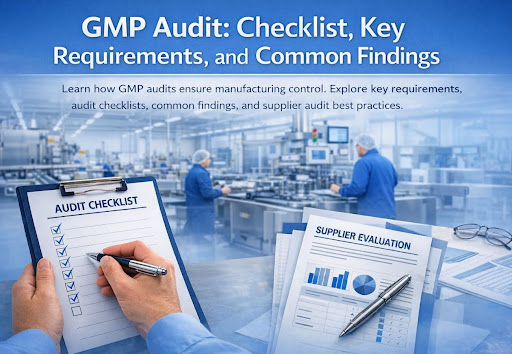
According to inspection data from regulatory authorities, more than 90% of GMP inspections result in acceptable compliance, but a notable minority still identify deficiencies in documentation and procedural execution. This article provides an overview of GMP audits, including key requirements, a detailed audit checklist, and the most frequently identified issues during audits.
What Is a GMP Audit?
A GMP audit is a systematic and independent examination of a manufacturing facility’s quality systems, processes, documentation, and operations to determine compliance with applicable GMP regulations and guidelines.
Regulatory agencies such as the U.S. Food and Drug Administration (FDA), European Medicines Agency (EMA), MHRA, and WHO conduct GMP inspections to protect public health.
In manufacturing environments, GMP audits are commonly used to evaluate supplier readiness, verify compliance with customer requirements, assess process capability, and identify operational risks that could affect quality, delivery, or cost. The audit typically includes document reviews, facility walkthroughs, employee interviews, and traceability exercises that follow materials and processes from receipt through final product release.
Why GMP Audits Are Critical in Manufacturing
Manufacturing operations depend on consistent control of people, equipment, materials, and processes. Weak or inconsistent controls increase the risk of defects, rework, scrap, and delivery disruptions. GMP audits identify these gaps early and help prevent quality and operational failures for the following reasons:
Ensure process consistency
Verify that manufacturing processes are clearly defined, controlled, and followed as written on the shop floor.
Prevent quality defects and errors
Identify gaps in process execution, operator practices, and documentation that can lead to nonconforming products.
Strengthen supplier quality and reliability
Assess whether suppliers have effective quality systems, traceability, and process controls in place.
Reduce operational and supply chain risk
Detect weaknesses that could cause production interruptions, material issues, or delivery delays.
Control the cost of poor quality
Address root causes of scrap, rework, and inefficiencies that increase manufacturing costs.
Support customer and compliance requirements
Provide objective evidence that manufacturing operations meet defined quality and contractual expectations.
Reinforce accountability and quality culture
Promote consistent adherence to procedures, training requirements, and corrective action processes.
Types of GMP Audits
Understanding the different types of GMP audits helps organizations prepare appropriately.
1. Internal GMP Audits
Also known as self-inspections, these are conducted by the company to:
- Identify gaps before regulatory inspections
- Assess compliance with internal procedures
- Drive continuous improvement
Internal audits are a regulatory expectation and a key component of an effective Quality Management System (QMS).
2. Regulatory Inspections
Performed by authorities such as FDA or EMA, these audits:
- Assess compliance with laws and regulations
- Can be routine, pre-approval, or for-cause
- May result in formal observations or enforcement actions
3. Supplier and Vendor Audits
These audits evaluate:
- Raw material suppliers
- Contract manufacturers (CMOs)
- Laboratories and service providers
Supplier qualification is a critical GMP requirement, as quality issues often originate upstream.
4. Customer Audits
Customers may audit manufacturers to ensure compliance before approving them as suppliers.
5. For cause audits
Triggered by quality issues, recurring nonconformances, complaints, or delivery failures.
These audits focus on specific processes or problem areas rather than the full quality system.
6. Follow-up or surveillance audits
Used to verify the implementation and effectiveness of corrective actions after previous audit findings.
Preparing for a GMP Audit
Effective GMP audits begin with preparation that is built into daily operations rather than last-minute efforts. Manufacturing sites that maintain audit readiness reduce risk, minimize disruptions, and respond more effectively to audit findings. Key preparation activities include:
Establish an Audit-Ready Culture
Audit readiness should be embedded in daily operations. Employees should:
- Follow procedures consistently
- Maintain accurate, contemporaneous records
- Understand the importance of GMP compliance
Define Audit Scope and Objectives
Before an audit:
- Identify applicable regulations (e.g., 21 CFR Parts 210/211, EU GMP)
- Understand the processes and systems in scope
- Assign subject matter experts (SMEs) and audit escorts
Document Readiness
Auditors heavily rely on documentation. Ensure:
- SOPs are current, approved, and followed
- Batch records are complete and accurate
- Deviations, CAPAs, and change controls are well documented
Train Employees
Employees should know:
- Their roles and responsibilities
- How to answer auditor questions truthfully and clearly
- When to escalate questions that they cannot answer
Verify Equipment and Facility Controls
Confirm that manufacturing infrastructure is audit-ready by checking:
- Equipment calibration and qualification status
- Preventive maintenance and cleaning records
- Environmental and facility controls, where applicable
Assign Audit Roles and Responsibilities
Designate knowledgeable personnel to:
- Support auditors during facility walkthroughs
- Answer technical and quality-related questions
- Provide requested documentation efficiently
Conduct Mock Audits
Mock audits and gap assessments help identify weaknesses, verify readiness, and reduce risk before formal GMP audits occur.
GMP Audit Checklist: Core Areas Auditors Review
A comprehensive GMP audit covers multiple systems and processes. Below is a practical checklist aligned with regulatory expectations.
1. Quality Management System (QMS)
Auditors assess whether the QMS effectively governs all GMP activities.
Key focus areas:
- Quality policy and objectives
- Management review and quality metrics
- Deviation and investigation management
- Corrective and Preventive Actions (CAPA)
- Change control processes
- Complaint handling
Common questions auditors ask:
- How do you ensure CAPAs are effective?
- How does management oversee quality performance?
2. Documentation and Data Integrity
Documentation is often summarized as: “If it is not documented, it did not happen.”
Key focus areas:
- SOP control and version management
- Good Documentation Practices (GDP)
- ALCOA+ principles (Attributable, Legible, Contemporaneous, Original, Accurate, plus Complete, Consistent, Enduring, Available)
- Record retention
- Electronic systems and audit trails
Data integrity is a top regulatory priority, and deficiencies here frequently lead to critical findings.
3. Personnel and Training
Qualified personnel are essential to GMP compliance.
Key focus areas:
- Organizational structure and responsibilities
- Job descriptions
- Training programs and effectiveness
- Training records
- Hygiene, gowning, and health requirements
Auditors often interview operators and technicians to verify training effectiveness.
4. Facilities and Equipment
Facilities and equipment must be designed and maintained to prevent contamination, mix-ups, and errors.
Key focus areas:
- Facility layout and flow
- Environmental monitoring
- HVAC systems
- Equipment qualification (IQ, OQ, PQ)
- Cleaning and maintenance programs
- Calibration
Poor facility controls can directly impact product quality and patient safety.
5. Materials Management
Material controls ensure traceability and prevent mix-ups.
Key focus areas:
- Supplier qualification and monitoring
- Incoming material inspection and testing
- Quarantine and release procedures
- Labeling and status identification
- Storage conditions
Auditors often trace a material from receipt through use in production.
6. Production and Process Controls
This area evaluates how products are manufactured.
Key focus areas:
- Master batch records
- In-process controls
- Process validation
- Yield reconciliation
- Cross-contamination controls
- Deviations during manufacturing
Consistency and adherence to approved procedures are critical here.
7. Laboratory Controls (Quality Control)
QC laboratories are frequently scrutinized.
Key focus areas:
- Analytical method validation
- Sample handling and chain of custody
- OOS (Out-of-Specification) and OOT (Out-of-Trend) investigations
- Reference standards
- Stability studies
- Data integrity in laboratory systems
Weak investigations are a common source of regulatory findings.
8. Packaging and Labeling
Packaging errors can have serious patient safety implications.
Key focus areas:
- Label control and reconciliation
- Line clearance procedures
- Packaging records
- Tamper-evident features
- Serialization and traceability (where applicable)
Auditors often observe packaging operations in real time.
9. Distribution and Supply Chain
Once products leave the facility, GMP responsibilities continue.
Key focus areas:
- Storage and transport conditions
- Cold chain management
- Distribution records
- Recall procedures
- Returned goods handling
This checklist serves as a practical reference for evaluating manufacturing readiness and identifying gaps that could impact quality, delivery, or compliance.
Key GMP Requirements and Regulatory Expectations
At its core, GMP requires manufacturers to demonstrate a consistent state of control over their operations to ensure products are produced safely, reliably, and to defined quality standards. This state of control is achieved through the following key elements:
Quality Management System (QMS)
A structured system for managing quality that defines policies, responsibilities, processes, and controls. The QMS is typically documented in a Quality Manual and supported by standard operating procedures and records.
Validation
Documented evidence that manufacturing processes, equipment, and cleaning methods consistently perform as intended. Validation confirms that processes are capable, repeatable, and under control.
Traceability
The ability to track materials, components, and products throughout the manufacturing lifecycle, from raw material receipt through production and final distribution. Effective traceability supports investigation, recall readiness, and accountability.
Risk-Based Approach
The use of risk assessments to identify critical processes, materials, and control points. A risk-based approach allows manufacturers to focus resources on areas with the greatest potential impact on quality and performance.
Data Integrity
Records must be accurate, legible, traceable, and protected from unauthorized changes.
Continuous Improvement
GMP systems should support ongoing monitoring, analysis, and improvement of manufacturing performance.
Strong GMP compliance is supported by disciplined execution, as outlined in Best Manufacturing Practices To Transform Your Operations.
Common GMP Audit Findings
Despite best efforts, certain findings appear repeatedly across inspections. Understanding common GMP audit findings helps manufacturers proactively address risks before audits occur.
1. Documentation and Record Deficiencies
- Incomplete or missing production and inspection records
- SOPs that are outdated or not followed
- Missing approvals, signatures, or dates
- Gaps between documented procedures and actual practices
2. Ineffective Corrective and Preventive Actions
- Weak or incomplete root cause analysis
- Actions that address symptoms instead of causes
- Delayed implementation of corrective actions
- Repeat findings for the same issues
3. Training and Competency Gaps
- Missing or outdated training records
- Personnel performing tasks without documented qualifications
- Operators unable to explain procedures
4. Equipment and Maintenance Issues
- Overdue calibrations or maintenance
- Incomplete cleaning or changeover records
- Equipment used outside defined parameters
5. Traceability and Material Control Weaknesses
- Poor material identification or status control
- Incomplete lot or batch traceability
- Gaps in supplier documentation
6. Change Management Gaps
- Changes implemented without formal evaluation
- Missing approvals or impact assessments
- Lack of retraining following changes
Classification of GMP Audit Findings
In the manufacturing industry, GMP audit findings are classified based on their potential impact on product quality, process control, and compliance. This classification helps prioritize corrective actions.
Critical findings
Indicate serious failures that may directly affect product quality or compliance. These require immediate action and senior management involvement.
Major findings
Reflect significant deficiencies that increase quality risk but do not pose an immediate threat. These must be corrected promptly to prevent escalation.
Minor findings
Low risk or isolated issues that do not significantly impact quality but highlight areas for improvement.
For FDA inspections, findings may be documented on Form 483, and unresolved issues can escalate to Warning Letters or other enforcement actions.
Responding to GMP Audit Findings
An effective response can significantly influence regulatory outcomes. Key Elements of a Strong Response
- Clear acknowledgement of the issue
- Thorough root cause analysis
- Specific corrective and preventive actions
- Realistic timelines
- Evidence of effectiveness
Responses should be factual, concise, and supported by data.
Best Practices for GMP Audit Success
Organizations that consistently perform well in audits share common traits:
- Continuous audit readiness
- Strong documentation practices
- Proactive risk management
- Effective training programs
- Visible management involvement
- Robust quality culture
For a deeper look at process-level evaluations, see our guide on Process Audit Checklist: Essential Steps.
Partner With AMREP Mexico for Reliable Supplier GMP Audits
GMP audits are essential for maintaining control, consistency, and quality across manufacturing operations. To effectively manage supply chain and production risk, audits must extend beyond internal operations. AMREP Mexico provides customized supplier factory auditing services focused on GMP, production risk analysis, supplier capability verification, and process control.
Contact AMREP Mexico to strengthen supplier performance and ensure your manufacturing supply chain operates with confidence and control.