Production Readiness Review (PRR): Checklist, Process, and Manufacturing Requirements
Written by AmrepMexico Supplier Quality Engineering Team, last updated in September 2026
A Production Readiness Review is a formal, cross functional evaluation conducted before a product enters full production to confirm that the design, the manufacturing process, the supply chain, the tooling, and the quality system are all genuinely ready to sustain the required volume at the required quality level. It is the gate that separates a program that looks finished on paper from one that is actually ready to run.
Manufacturers that skip this step, or treat it as a formality, often discover the gaps only after the line is running and the customer is waiting on parts. This guide breaks down what a Production Readiness Review actually covers, who should be in the room, the complete checklist used across automotive, aerospace, medical device, and electronics manufacturing, and how the review fits alongside PPAP, APQP, and Run at Rate.
What Is a Production Readiness Review?
A Production Readiness Review, often shortened to PRR, is a structured checkpoint where a cross functional team validates that a product and its supporting production system meet every requirement needed to enter and sustain volume manufacturing. The review looks at the complete production ecosystem rather than a single department.
This includes the product design itself, the manufacturing process that will build it, the people who will run that process, the materials and components feeding it, the tooling and equipment supporting it, and the quality system monitoring it. A PRR asks one central question. Can this product be built, at this rate, with this quality, using these resources, starting now?
The review typically produces one of three outcomes.
- Full approval to proceed into production
- Conditional approval with a defined list of open items and closure dates
- Hold, with production delayed until specific gaps are resolved
Why Production Readiness Reviews Matter in Mexico Manufacturing
Mexico has become a primary nearshoring destination for automotive, aerospace, medical device, and electronics OEMs relocating or expanding production out of Asia. New program launches in Mexico frequently involve new suppliers, newly hired production teams, and equipment that has just been installed or relocated.
Every one of those variables raises launch risk. A Production Readiness Review gives OEMs and their supplier quality teams a documented, evidence based way to confirm a supplier's plant in Tijuana, Guadalajara, Querétaro, or Mexico City is actually prepared before the first production order ships, rather than discovering gaps during the first weeks of live production.
For OEMs managing suppliers remotely from the United States, Canada, or Europe, a well run PRR also closes the distance and language gap. It replaces a status call with physical evidence: verified tooling, trained operators, approved control plans, and a documented capacity study.
When to Conduct a Production Readiness Review
- A PRR sits near the end of the Advanced Product Quality Planning process, after design and process validation activities are largely complete but before the customer authorizes full production shipments. It is closely linked to the Production Part Approval Process, the standardized approval package that confirms a supplier's process can consistently meet the customer's engineering and quality requirements.
- Common triggers for a Production Readiness Review include the following.
- A new product or part number is entering production for the first time
- A product is transferring from one facility to another, including relocations into Mexico
- A significant design change or engineering change order has been implemented
- A new supplier or sub-supplier is being brought into the program
- Major process changes have occurred, such as new tooling, new equipment, or a new production line
- Production has restarted after an extended shutdown
Complex products with multiple sub-suppliers, tight tolerances, or safety critical characteristics generally warrant a more detailed review than simple, low risk components.
Who Should Be Involved in a Production Readiness Review
- A Production Readiness Review is a team activity, not a single engineer's checklist. Excluding a function from the review is one of the most common reasons issues surface later.
- Design and product engineering, to confirm the design record is complete and stable
- Manufacturing and process engineering, to confirm the process is capable and repeatable
- Quality engineering, to confirm inspection plans, control plans, and PPAP status
- Procurement and supply chain, to confirm materials and components are available
- Production management, to confirm staffing, scheduling, and facility readiness
- Supplier quality, when a supplier's plant is the subject of the review
- Customer representatives, in cases where the OEM requires direct sign off
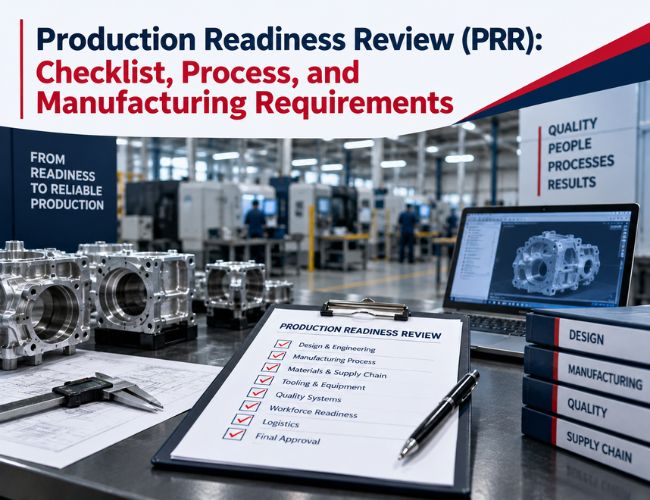
The Complete Production Readiness Review Checklist
The categories below reflect the manufacturing requirements most commonly assessed during a PRR across automotive, aerospace, medical device, and electronics programs.
Design and Engineering Readiness
- Design record, drawings, and specifications are final and released
- All engineering change orders have been incorporated and verified
- Critical and special characteristics are clearly identified on the drawing and control plan
- Design FMEA has been completed and high risk items addressed
- Product has passed all required design validation testing
Manufacturing Process Readiness
- Process flow diagram matches the actual production line layout
- Process FMEA has been completed and mitigations are in place for high risk steps
- Control plan is documented, approved, and posted at the work station
- Process capability studies confirm Cpk or Ppk values meet customer requirements
- Cycle times have been verified against the required production rate
- Standard work instructions exist for every operation and are available in the operators' language
Quality System Readiness
- PPAP has been submitted and approved, or has a defined closure date
- Measurement System Analysis has been completed for all critical gauges
- Inspection and test equipment is calibrated and available at the correct stations
- Nonconforming material process and containment procedures are defined
- Corrective action process is documented and understood by the production team
- Internal audit or IATF 16949 supplier audit findings have been closed
Supplier and Material Readiness
- All raw materials and purchased components are qualified and available
- Sub-supplier PPAP submissions are complete for any sub-tier parts
- Material certifications match specification requirements
- Incoming inspection plan is defined for critical components
- Lead times and safety stock levels support the launch schedule
Tooling and Equipment Readiness
- Tooling has been built, validated, and is available in the production location
- Preventive maintenance schedules exist for all critical equipment
- Backup tooling or contingency plans exist for single source tools
- Fixtures and gauges have been verified against the part specification
- Equipment has been installed, calibrated, and signed off by maintenance and quality
Workforce Readiness
- Operators have been trained on the specific process and documented
- Training records exist and are traceable to the current work instructions
- Staffing plan supports the required shifts and production volume
- Skills matrix identifies backup coverage for critical operations
- Error proofing devices are installed and verified functional
Documentation and Compliance Readiness
- All required customer specific requirements have been reviewed and addressed
- Safety data sheets and environmental compliance documents are current
- Packaging and labeling specifications have been validated
- Traceability system is in place from raw material to finished product
- Customer required certifications, such as ISO or IATF, are current and valid
Logistics and Launch Readiness
- Shipping and packaging validation is complete
- Logistics plan supports the required delivery schedule
- Launch containment or early production containment plan is defined
- Escalation path is documented for quality issues during the first weeks of production
- Communication plan exists between the plant and the customer during ramp up
The Production Readiness Review Process
A structured PRR generally follows five steps.
- Preparation. The service owner or program manager compiles evidence against the checklist ahead of the review, rather than trying to answer questions live in the room.
- Walkthrough. The cross functional team reviews each checklist category, confirms evidence, and asks clarifying questions. An on-site tour of the actual production area, including the build stations and inventory of production parts, adds confidence beyond a document review.
- Gap identification. Every open item is logged with an owner, a required action, and a closure date. Items are typically scored as pass, conditional pass, or fail.
- Disposition. A designated reviewer or review chair determines whether the product proceeds into production, proceeds with conditions, or is held.
- Follow up. Open items are tracked to closure, and in many programs a short follow-on review confirms that all conditions have been met before full rate production begins.
Production Readiness Review vs PPAP vs Run at Rate
These three activities are related but answer different questions, and confusing them is a common source of launch delays.
A Production Readiness Review asks whether the entire production system, across design, process, quality, supply chain, tooling, and people, is prepared to enter production. PPAP evaluates whether the supplier's manufacturing process can consistently produce parts that meet the customer's engineering and quality requirements, and it is documented through a formal submission package. Run at Rate is a capacity study that demonstrates the process can meet the quoted production rate under normal operating conditions, using the actual tooling and operators.
In practice, many programs treat PRR as the broader readiness gate, with a completed PPAP Level 3 submission and a successful Run at Rate serving as two of the pieces of evidence reviewed inside it.
How to Score a Production Readiness Review
Most programs score each checklist item using a simple three tier system rather than a pass or fail toggle for the entire review. This keeps the process practical and focuses attention on the items that actually carry launch risk.
- Pass. The requirement is fully met, with objective evidence available on request.
- Conditional pass. The requirement is substantially met, with a minor gap that carries an assigned owner and a closure date before production ramps to full volume.
- Fail. The requirement is not met, and the item blocks production until it is resolved.
A program with several conditional passes and no failures can often proceed into limited or controlled production while the open items close. A program with any failed item tied to a safety characteristic, a missing PPAP approval, or unqualified tooling should hold until that specific gap is resolved. Scoring this way keeps the review focused on real risk rather than a simple checklist completion percentage.
Common Risks of Skipping a Production Readiness Review
- Rushing or skipping this step tends to move problems downstream, where they are far more expensive to fix. Typical consequences include the following.
- Line stoppages during the first weeks of production due to untested processes
- Scrap and rework costs from process capability issues that were never verified
- Missed delivery dates caused by material shortages that were not identified early
- Customer containment activity and added inspection costs after nonconforming parts ship
- Damaged customer relationships when quality issues surface at the OEM's receiving dock instead of at the supplier
A structured PRR catches these issues while they are still inexpensive to correct, before the customer, the assembly line, or the end user is affected.
Best Practices for Running an Effective PRR in a Mexico Manufacturing Environment
- Programs launching or transferring production into Mexico benefit from a few specific practices.
- Conduct the review on-site whenever possible, so the team can see actual tooling, inventory, and operators rather than relying on a remote status update
- Confirm that work instructions and training materials exist in the language spoken on the floor, not only in the OEM's home language
- Verify supplier and sub-supplier readiness explicitly, since new programs in Mexico often involve a newly qualified supply base
- Use local, bilingual supplier quality engineers to bridge communication between the plant floor and the OEM's engineering and quality teams
- Document every open item with an owner and a date, and track it the same way a formal PPAP or Run at Rate deviation would be tracked
How AmrepMexico Supports Production Readiness Reviews
AmrepMexico's local supplier quality engineers conduct on-site Production Readiness Reviews for OEMs launching or transferring production to suppliers across Tijuana, Guadalajara, Querétaro, San Luis Potosi, Mexico City, and Puebla. Our team verifies tooling, process capability, PPAP status, workforce training, and supplier readiness directly on the plant floor as part of our broader production management support, then reports findings back to your program team in a format your organization already uses.
For OEMs managing new supplier launches, facility transfers, or program relocations into Mexico, having local engineers physically walk the line before production begins removes the guesswork and the language barrier that remote reviews cannot fully resolve.
Frequently Asked Questions
What is the difference between a Production Readiness Review and a Manufacturing Readiness Assessment?
A Manufacturing Readiness Assessment generally evaluates production capability and manufacturing maturity across an entire organization or facility. A Production Readiness Review is project specific, evaluating whether one particular product or part number is ready to enter production.
How long does a Production Readiness Review take?
Duration depends on product complexity. A simple, low risk component may be reviewed in a few hours, while a complex product with multiple sub-suppliers and production lines may require several review sessions spread across a full day or more.
Does a Production Readiness Review replace PPAP?
No. A Production Readiness Review is a broader readiness gate that considers the entire production system, while PPAP is a specific, documented approval package focused on the part and the process that produces it. Many programs use PPAP approval as one input into the PRR.
Who signs off on a Production Readiness Review?
Sign off authority varies by program, but it is typically held by a program manager, quality manager, or a designated review chair with input from every function represented in the review, including design, manufacturing, quality, and supply chain.
What happens if a Production Readiness Review identifies open issues?
Open issues are logged with an assigned owner and a closure date. Depending on severity, the product may receive conditional approval to proceed while issues are resolved, or production may be held until the gaps are closed.
Verify Your Suppliers with AmrepMexico
A Production Readiness Review is only as strong as the team conducting it. AmrepMexico's local supplier quality engineers bring the on-site presence, bilingual communication, and manufacturing expertise needed to verify your suppliers are truly ready before production begins.
Connect with our expert engineers to schedule a Production Readiness Review for your next program launch or supplier transfer in Mexico.