GP-12 Safe Launch: Requirements, Process, and Early Production Containment
Written by AmrepMexico Supplier Quality Engineering Team, last updated in August 2026.
Written by AmrepMexico Supplier Quality Engineering Team, last updated in August 2026.
GP-12 Safe Launch is General Motors' Early Production Containment procedure, requiring suppliers to run a separate, enhanced inspection process on every part during a new launch or after a major quality event until the process proves stable. It exists to stop non-conforming parts from ever reaching the OEM's assembly line.
This guide covers what triggers GP-12, what the process actually requires, how it differs across OEMs, and how to run it inside a Mexico production facility.
What Is GP-12 Safe Launch?
GP-12 is General Motors' formal name for Early Production Containment, sometimes just called EPC. Safe Launch is the broader industry term used across the automotive supply base for the same basic concept: a temporary, 100 percent inspection firewall placed between a supplier's production line and the OEM's plant.
The purpose is straightforward. It protects the OEM from receiving defective parts during periods of elevated risk, and it forces the supplier to prove, with real data, that its process is under control.
GP-12 typically requires:
- A documented containment plan approved by the OEM's Supplier Quality Engineer
- A physically separate inspection station, away from normal production
- 100 percent inspection of every part against defined criteria
- Daily data tracking and defect reporting to the OEM
- Clear exit criteria the supplier must meet before returning to normal shipping
GP-12 by OEM: Naming and Terminology Differences
GP-12 is a GM term, but every major OEM running production in Mexico's automotive industry has an equivalent program under a different name. Suppliers working across multiple OEMs need to know all of them, because the underlying discipline is the same even though the paperwork and terminology are not.
| OEM or Tier 1 | Program Name | Current Term |
|---|---|---|
| General Motors | GP-12 | Early Production Containment (EPC) |
| Ford | Pre-Launch Control Plan | Pre-Launch Control Plan |
| Stellantis | Safe Launch Plan | GSQN-004 Global Proactive Containment |
| WABCO and similar Tier 1 customers | Safe Launch | Safe Launch |
| ZF | Safe Launch | Harmonized Safe Launch Process |
A supplier shipping to more than one of these customers at the same time may be running several containment programs in parallel, each with its own documentation format and reporting cadence.
When Is a Supplier Placed on GP-12?
GP-12 is not a routine requirement. It is triggered by specific events that raise an OEM's risk concern about a part or a plant. Common triggers include:
- A new product launch during the APQP or PPAP phase
- A quality escape that already led to Controlled Shipping Level 1 or Level 2
- A process or site change, such as new tooling, new materials, or a plant relocation
- A pattern of repeated quality issues tied to a specific part
- Systemic weaknesses found during an OEM quality system audit
GP-12 vs CS1 and CS2: Where It Fits
GP-12 and Controlled Shipping address different moments in a supplier's quality timeline. GP-12 is proactive. It is applied during a launch or a process change, before problems have necessarily occurred, to prove the new process is capable from the start.
Controlled Shipping Level 1 and Level 2 are reactive. They are triggered after a quality escape has already reached the customer, and they escalate in intensity if the supplier fails to contain the issue. In practice, a supplier that fails a GP-12 launch containment can end up moving into CS1 or CS2 if defective parts get through.
GP-12 Safe Launch Requirements
An OEM SQE reviewing a GP-12 submission is generally looking for the same core elements, regardless of which customer's naming convention is in use.
- A named individual responsible for the containment process
- A formally documented Pre-Launch Control Plan covering all known critical characteristics
- A segregated inspection area, physically separated from standard production
- Visual work instructions with boundary samples showing conforming and non-conforming parts
- A defined method for marking certified parts, commonly a green dot or equivalent label
- Daily reporting of inspection results to the OEM
These requirements trace back to the Advanced Product Quality Planning and Control Plan framework under IATF 16949, which is why OEM SQEs expect the same documentation discipline regardless of which specific program name is being used.
The GP-12 Documentation Package
Beyond the general requirements, an SQE will expect to see a specific set of documents before approving or closing out a GP-12 submission. Having these ready in advance shortens both the approval and the exit process.
- Pre-Launch Control Plan. The core document listing every characteristic being checked, the method, the frequency, and who is responsible.
- Boundary sample photos. Side-by-side images of barely acceptable and barely rejectable parts, used to train and calibrate inspectors.
- Daily inspection tracking log. A running record of parts inspected, passed, failed, and the specific defect type for each rejection.
- Pareto chart of defects. Updated daily so the team can see which defect mode is driving the most rejections.
- Daily summary report to the OEM. A short status update sent to the SQE covering volume inspected, defect rate, and corrective action progress.
- Exit request package. The formal submission at the end, combining the tracking data, Cpk results, and confirmation that all identified issues are closed.
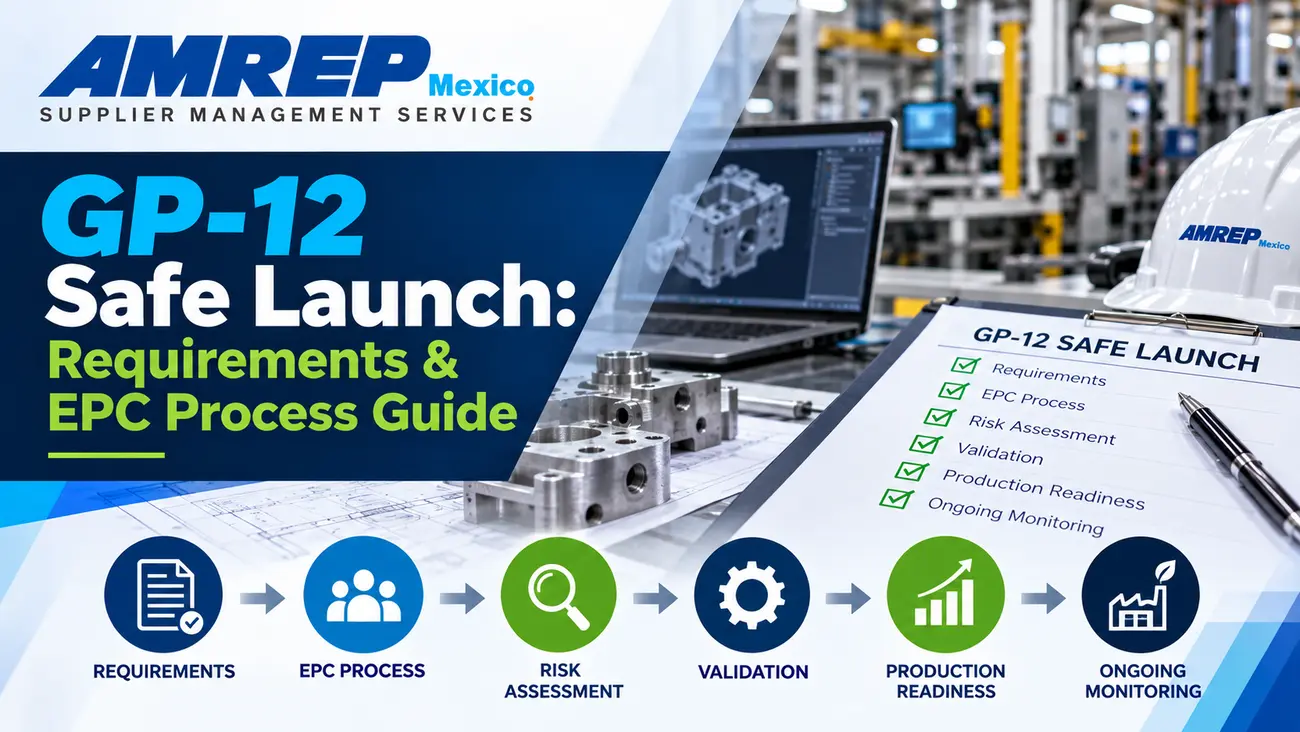
The GP-12 Process: Step by Step
- Define and document the containment control plan. Assemble a cross-functional team covering quality, production, and engineering. Document the affected part numbers, defect modes, and inspection methods, and submit the plan for OEM SQE approval.
- Set up the segregated containment station. Physically separate the station from normal production flow, with clear entry and exit points, proper lighting, and enough space for inspectors to work without fatigue.
- Train inspectors and finalize work instructions. Provide laminated visual instructions with boundary samples and make sure every inspector on every shift understands the exact acceptance criteria.
- Run 100 percent inspection and track data daily. Log every part inspected, passed, and failed. Build a Pareto chart of defect types and update it daily so trends are visible to the whole team.
- Report defect trends and drive root cause corrective action. Containment data should feed directly into engineering's root cause investigation. Containment alone does not fix the process; it only stops bad parts from shipping.
- Submit the exit request against defined criteria. Once the data supports it, submit a formal exit request to the OEM SQE with evidence that the underlying process issue has been resolved.
GP-12 Exit Criteria
The OEM sets exit criteria, which vary by customer and by the severity of the issue that triggered GP-12. Common elements include:
- A minimum number of consecutive defect-free parts shipped, historically cited around 1200 pieces in some GM programs
- A defined issue-free time window, such as two consecutive weeks with no defects found at the containment station
- Documented improvement in process capability, commonly measured through Cpk
- Formal closure of every issue identified during the containment period
Suppliers should confirm the exact thresholds with their OEM SQE rather than assuming a standard number applies across all programs.
Running GP-12 Containment at a Mexico Production Facility
Running GP-12 inside a Mexico plant carries a few practical challenges that a US or Canadian OEM customer will not necessarily see from a distance. These challenges also vary depending on whether the plant sits in a border or interior manufacturing location.
Staffing on short notice. A GP-12 notification can arrive with little warning, and containment stations often need to run around the clock. Facilities in Tijuana, Guadalajara, and Mexico City need access to trained inspectors who can be mobilized quickly.
Bilingual communication with the OEM SQE. Daily reports, containment plans, and exit requests need to be accurate in both English and Spanish, and someone on-site needs to be able to speak directly with the OEM's quality engineer without a language gap slowing down decisions.
Coordinating with cross-border logistics. Containment can affect shipping timelines, which matters more when parts are crossing the US-Mexico border on a tight production schedule.
Parallel root cause support. Containment buys time, but it does not fix anything on its own. Local engineering resources need to be working the root cause investigation at the same time the containment station is running.
Illustrative Example: A GP-12 Launch at a North Mexico Supplier
The following is a composite, illustrative scenario, not a specific client case.
A Tier 1 supplier in the Tijuana region launches a new stamped metal component for a GM program. During the ramp-up phase, the OEM places the part on GP-12 due to early dimensional variation found during PPAP trials.
The supplier stands up a segregated containment station within 48 hours, staffed across three shifts. Inspectors check 100 percent of parts against a boundary sample set and log results into a daily tracking sheet. A Pareto chart shows one specific dimension driving most of the variation, which engineering traces back to a tooling wear issue.
The tooling is corrected, and the containment data shows zero defects over the following two weeks. The supplier submits an exit request with the supporting Cpk data, and the OEM SQE approves the exit, returning the part to standard shipping.
Common Pitfalls That Extend a GP-12 Mandate
Treating GP-12 as a quality department problem instead of a plant-wide priority. When production and engineering leadership stay disengaged, containment drags on because nobody outside quality feels urgency to fix the root cause.
Using undertrained or temporary inspectors. Inspectors who do not fully understand the defect criteria produce inconsistent results, which erodes OEM confidence and can trigger a request to restart the containment period.
Falsifying or rushing inspection records. Sometimes called pencil whipping, this is the fastest way to permanently damage OEM trust. If discovered, it can lead to a much longer containment period or a formal audit.
Focusing entirely on the inspection firewall while neglecting root cause engineering. Containment stops defects from shipping, but it does not fix anything. Suppliers that treat containment as the solution rather than a temporary measure often stay on GP-12 far longer than necessary. A structured approach to solving supplier quality issues can shorten that timeline considerably.
Frequently Asked Questions
How long does GP-12 typically last?
There is no fixed duration. It runs until the supplier meets the OEM's defined exit criteria, which can range from a couple of weeks to several months depending on how quickly the root cause is resolved.
Who decides when a supplier can exit GP-12?
The OEM's Supplier Quality Engineer makes the final call, based on the data the supplier submits against the agreed exit criteria.
Is GP-12 the same as PPAP?
No. PPAP is the process used to approve a part for production. GP-12 is a containment measure applied during or after that approval process when the OEM needs extra assurance that the part is being produced consistently.
Can a supplier be placed on GP-12 more than once?
Yes. A supplier can be placed on GP-12 again for a different part, a new launch, or a repeat quality issue, even if a previous GP-12 mandate was successfully closed out.
Does GP-12 apply outside the automotive industry?
GP-12 itself is a GM-specific term, but the same containment concept, an enhanced inspection firewall during a high-risk period, is used under different names in aerospace and other regulated manufacturing sectors.
How AmrepMexico Supports GP-12 Safe Launch Programs
Running a GP-12 containment station inside a Mexico facility takes dedicated staffing, bilingual reporting, and coordination with the OEM SQE, all while engineering works the root cause in parallel. AmrepMexico's local Quality Inspection services handle the on-site containment execution, from station setup to daily data reporting, so your internal team can stay focused on the permanent fix.