Controlled Shipping Level 1 vs Level 2: CS1 and CS2 Explained
Written by Amrep Mexico Supplier Quality Engineering Team, last updated in Aug 2026 Controlled Shipping Level 1 (CS1) requires a supplier to add a 100 percent inspection using its own staff at its own facility. Controlled Shipping Level 2 (CS2) adds a second, independent inspection performed by an OEM-approved third party, effectively doubling inspection coverage on the same parts, and gets triggered when CS1 fails to stop nonconforming parts from reaching the customer. Both are containment measures an OEM imposes on a supplier after a quality escape, not a permanent status, and both stay in place until the supplier proves the root cause is fixed. This guide covers what controlled shipping is, how CS1 and CS2 differ, what triggers each level, how exit criteria work, how OEM naming and requirements vary, a worked example timeline, and how suppliers should respond once they're placed under either level.
What Is Controlled Shipping
Controlled shipping is an OEM-imposed containment program that protects the customer when a supplier has shipped, or may ship, nonconforming parts. The supplier adds a focused inspection layer to its normal quality controls. The inspection targets the specific characteristic or condition that created the quality concern. The supplier continues its regular quality gates while the additional containment runs in parallel. The practice traces back to General Motors supplier quality documentation, including GP5, also referenced as GM1746, which defines Controlled Shipping Level 1 and Level 2 as escalation tools within the supplier corrective action process. Other OEMs use similar approaches under their own terminology and customer-specific requirements. Controlled shipping serves two purposes:
- Contain the immediate risk so defective parts do not continue reaching the customer.
- Restore confidence by giving the OEM documented evidence that the supplier has corrected the problem.
It differs from a routine supplier audit because an OEM typically introduces controlled shipping in response to a specific quality concern or escape, rather than as part of a normal audit schedule.
CS1 vs CS2 at a Glance
| Factor | CS1 | CS2 |
|---|---|---|
| Who inspects | Supplier's own staff | Independent third party, OEM-approved |
| Inspection coverage | 100 percent of shipments | 100 percent again, on top of CS1, effectively 200 percent combined coverage |
| Inspection location | Usually at the supplier's facility | Often required outside the supplier's facility |
| Who pays | Supplier | Supplier |
| What triggers it | A nonconformance escape or quality issue | CS1 fails to stop escapes, or the issue is severe |
| Typical duration | Until exit criteria are met | Until exit criteria are met, usually longer than CS1 |
The simplest way to remember the difference is: CS1 = supplier-controlled containment CS2 = supplier containment + independent verification CS2 therefore adds another layer of confidence rather than replacing the supplier's existing CS1 activities.
What Triggers Controlled Shipping, and How OEMs Decide Between CS1 and CS2
An OEM can place a supplier on controlled shipping after a quality event that creates concern about the supplier's ability to prevent nonconforming parts from reaching the customer. Common triggers can include:
- A defective part reaches the OEM's production line.
- A quality issue contributes to a line stoppage.
- A recurring nonconformance appears across multiple shipments.
- A customer complaint identifies a supplier-related process failure.
- Defect performance exceeds a customer-defined threshold.
- A serious or safety-related issue creates an immediate containment concern.
The exact trigger depends on the OEM, customer agreement, product risk, and severity of the issue. Suppliers should always follow the specific requirements in the customer's containment notice rather than rely on a generic threshold.
Controlled Shipping Level 1 (CS1) Explained
CS1 is the supplier's own responsibility to contain and correct the problem, verified through inspection data the supplier reports to the OEM.
- Contain all suspect material at the supplier's facility, in transit, and at the customer if needed
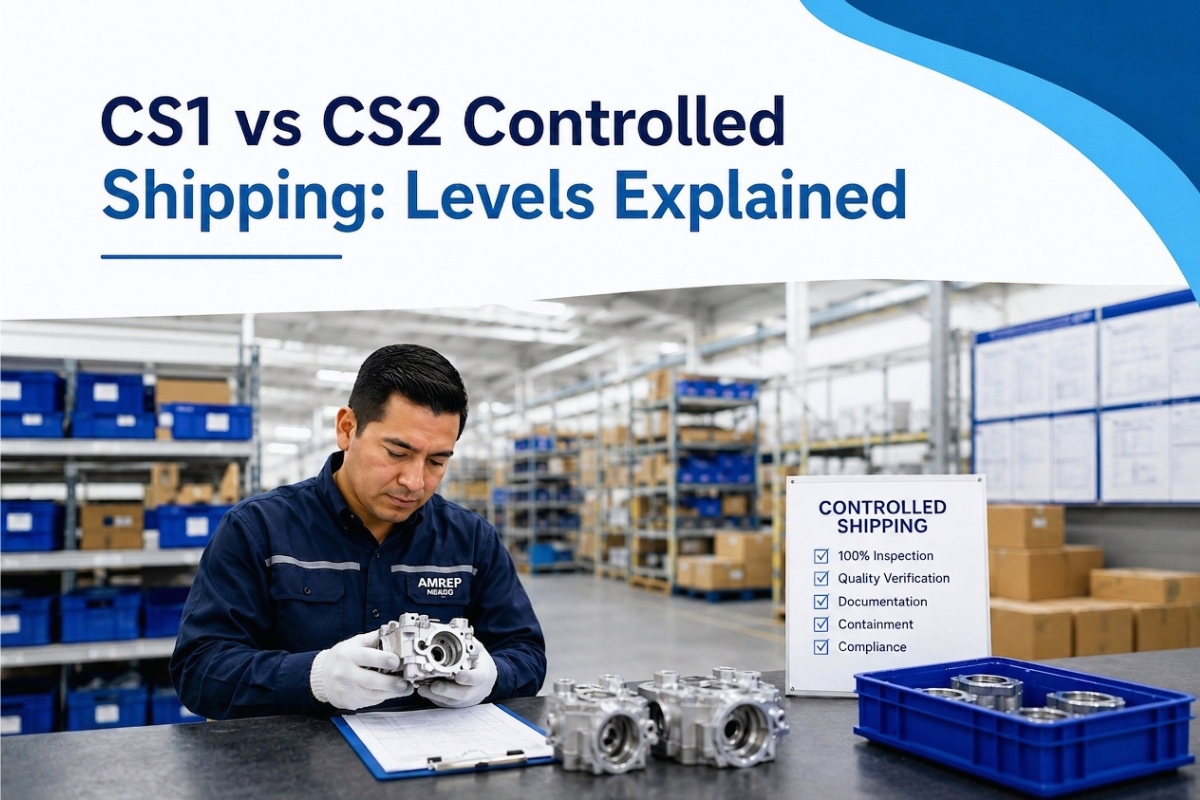
- Perform 100 percent inspection on all shipments until the issue is resolved, built around a quality inspection checklist specific to the nonconforming characteristic.
- Identify the root cause of the nonconformance
- Implement corrective action, ideally irreversible, not just a temporary fix
- Report inspection data to the OEM on the agreed frequency
Some suppliers run CS1 inspections with their own staff. Others bring in an outside inspection company to handle the added workload, particularly if internal resources are already stretched. Inspected parts are typically marked to confirm they've passed the added check, commonly with a label or a colored dot applied with a paint marker, so downstream handlers can visually confirm a part has cleared containment.
Controlled Shipping Level 2 (CS2) Explained
CS2 keeps everything required under CS1 and adds an independent verification layer.
- All CS1 requirements continue, including internal inspection and corrective action work
- A third-party inspection provider, selected from the OEM's approved vendor list or mutually agreed upon, performs an additional 100 percent inspection
- The third-party inspection is often required to happen outside the supplier's own facility, unless the OEM approves an exception
- The supplier is financially responsible for the third-party inspection cost
- Root cause and corrective action work from CS1 must continue until the data proves it's actually effective, often with sign-off from a third-party quality engineer confirming the corrective action holds
CS2 is a stronger signal to the OEM: the supplier's own quality system is not yet trusted enough to catch the problem on its own.
Beyond CS2: When Escalation Continues
If CS2 does not resolve the issue, some OEMs escalate further to a third level, sometimes formally named CSL3 and other times referred to informally as "business on hold." At this stage, the supplier is typically barred from winning new business with that customer, and any in-progress project awards may be suspended until the supplier demonstrates sustained corrective action. Not every OEM formally names this third tier, but the underlying consequence, losing new business consideration, is a common outcome once containment drags on without resolution.
Exit Criteria: How Suppliers Get Out of Controlled Shipping
Exit criteria are set by the OEM and generally follow a consistent pattern across the industry, though the exact numbers vary by customer.
- A defined number of consecutive clean shipments or clean production days, commonly in the range of 20 to 30 days, with zero escapes
- Documented, verified root cause analysis
- Evidence that corrective actions are effective and irreversible, not just a temporary workaround
- Error-proofing or process controls in place to prevent recurrence
The exit process itself typically follows a set sequence on the OEM side. The supplier quality engineer confirms all exit criteria have been met and reviews the supplier's overall quality performance during the containment period. The OEM verbally notifies the supplier that criteria have been satisfied, followed by a formal written exit letter confirming the end of containment. The exit is then logged in the OEM's internal quality tracking system, closing out the record. Some customer agreements also require the supplier to formally notify their own IATF 16949 certification registrar once placed under controlled shipping status, typically within a defined window such as 5 working days. This requirement varies by customer contract, so suppliers should confirm it against their own specific customer-specific requirements document rather than assume it applies universally. Meeting exit criteria for CS1 does not guarantee a supplier avoids CS2 or a return to controlled shipping later. If a new nonconformance surfaces after exit, the OEM can reinstate containment, and a supplier with a history of repeated CS1 or CS2 events is reviewed more closely on future occurrences. A supplier's history of CS1 or CS2 containment is also a factor OEMs weigh when setting future audit cadence, so exiting containment cleanly doesn't necessarily mean returning to the previous audit schedule right away. See our supplier audit frequency guide for how risk history shapes how often a supplier should be audited going forward.
A Worked Example: CS1 to CS2 to Exit
Consider an automotive supplier that discovers a dimensional defect in an assembled component.
Week 1: CS1
The OEM identifies the defect and places the supplier on CS1. The supplier immediately:
- Contains suspect inventory
- Begins 100% inspection
- Starts root cause analysis
- Reports inspection results to the OEM
Weeks 2–4: Investigation
The supplier discovers that worn tooling caused the dimensional variation. The team replaces the tooling and begins verifying the corrective action.
Week 5: CS2
Another defective part reaches the OEM. Because the supplier's CS1 controls failed to prevent another escape, the OEM escalates the supplier to CS2. The supplier continues its internal containment while an independent inspection provider performs the additional inspection.
Weeks 6–8: Corrective Action
The supplier completes the tooling replacement and adds an error-proofing control. The inspection provider records clean results while the supplier continues monitoring the process.
Week 9: Exit
Once the supplier satisfies the OEM's defined exit criteria, the OEM formally releases the supplier from controlled shipping. The exact timeline and number of clean production days will vary by OEM and situation. The important sequence remains: Contain → Investigate → Correct → Verify → Demonstrate sustained control → Exit
How OEM Naming and Requirements Differ
The mechanics of controlled shipping are similar across major automotive OEMs, but the terminology and specific procedural details are not always the same.
- General Motors uses Controlled Shipping Level 1 and Level 2, formally documented in GM's GP5 (GM1746) supplier quality guideline, the original reference document the broader industry's CS1/CS2 terminology is built on.
- Ford uses its own Controlled Shipping terminology within its supplier quality escalation process, following a broadly similar containment and exit structure but documented through Ford's own customer-specific requirements rather than GM's GP5.
- Stellantis (formerly FCA and PSA) refers to the same underlying concept as 3CPR, previously called CSL, ties the escalation to IATF 16949 Clause 9.1.2.1 on customer satisfaction, and typically runs final goods control activity for around 5 weeks per escalation event.
- Mercedes-Benz and several other OEMs operate similar two-level control shipment processes, generally described simply as Level 1 and Level 2, tied to their own customer-specific requirements documents.
Because each OEM documents its own version of this process, suppliers working with multiple customers should treat each containment notice as governed by that specific customer's requirements document, rather than assuming one OEM's rules apply universally. Regardless of the name, the underlying structure is consistent: an internally-run first level, and a third-party-verified second level triggered when the first fails.
Why Controlled Shipping Matters for Suppliers in Mexico
Mexico plays an important role in North American automotive manufacturing, which makes supplier quality containment a critical operational issue for companies serving major OEM programs. When an OEM places a Mexican supplier under CS1 or CS2, the supplier needs to respond quickly. That response can become more difficult when the supplier needs an independent inspection provider on short notice. The supplier may need to coordinate:
- Inspector availability
- Facility access
- Inspection criteria
- Bilingual communication
- Inspection documentation
- Daily reporting
- Material identification
- OEM-specific requirements
A local inspection partner can help suppliers respond faster and maintain the required containment process while their internal quality team focuses on root cause and corrective action. Suppliers can also reduce the risk of reaching controlled shipping by evaluating supplier capability before production begins. A thorough technical evaluation of a new supplier in Mexico during sourcing catches process capability gaps early, before they turn into a containment event down the line.
How to Respond When You're Placed on CS1 or CS2
The suppliers who exit containment fastest tend to follow the same sequence.
- Contain suspect material immediately across the supplier's facility, in-transit stock, and any material already at the customer
- Confirm the communication and reporting format the OEM expects, and follow it exactly
- Begin root cause analysis right away rather than waiting for a formal kickoff meeting
- If in CS2, select and confirm a third-party inspection provider from the OEM's approved list without delay
- Track and report clean shipment data consistently from day one, since gaps in reporting can reset the clock
A few recurring mistakes tend to extend time in containment longer than necessary.
- Treating the corrective action as a quick fix instead of addressing the true root cause
- Inconsistent or late data reporting, which undermines the OEM's confidence in the numbers
- Poor communication cadence with the OEM once containment is underway
- Selecting a third-party inspection provider without confirming OEM approval first, which can invalidate the inspection
Common Mistakes That Extend Controlled Shipping
Suppliers often extend containment by focusing on the immediate defect without addressing the system behind it.
- Treating containment as the corrective action: 100% inspection can catch defects, but it does not remove the cause.
- Fixing the symptom instead of the root cause: Replacing one component may temporarily solve the problem while the underlying process weakness remains.
- Reporting incomplete data: Missing inspection records or inconsistent reporting can create unnecessary questions from the OEM.
- Ignoring recurring findings: A repeat defect indicates that the corrective action may not have addressed the true cause.
- Choosing an unapproved third-party inspector: CS2 requirements may specify an approved provider or approval process. Confirm this before starting inspection.
- Treating OEM requirements as interchangeable: A procedure that works for one customer may not satisfy another customer's requirements.
How AmrepMexico Supports CS1 and CS2 Containment in Mexico
AmrepMexico provides local, independent source inspection services across Tijuana and North Mexico, Guadalajara and Central Mexico, and Mexico City and South Mexico, giving OEMs and suppliers a fast, on-the-ground response when controlled shipping is imposed. Our inspectors work directly at the supplier's facility or at an independent location when CS2 requires separation, with data reported back on the schedule your OEM requires. Contact our inspection team to set up containment support for a supplier under CS1 or CS2 in Mexico.
Frequently Asked Questions
Is CS2 the same as 3CPR?
3CPR is Stellantis's name for its containment escalation process, formerly called CSL. It follows the same internal-then-third-party structure as CS1 and CS2, just under different terminology.
Who pays for the CS2 third-party inspection?
The supplier is financially responsible for the third-party inspection cost under CS2, even though the OEM typically approves or provides the list of eligible third-party providers.
Can a supplier go straight to CS2 without going through CS1 first?
Yes, in cases where the initial defect is severe enough, such as a safety-critical failure, or the OEM has lost confidence in the supplier's internal inspection capability, the OEM can place a supplier directly into CS2 rather than starting at CS1.
How long does a supplier typically stay in CS1?
There is no fixed duration. A supplier stays in CS1 until it meets the OEM's exit criteria, usually a set number of consecutive clean shipments or production days, which commonly falls in the 20 to 30 day range depending on the customer.
Does being placed on controlled shipping affect IATF 16949 certification status?
Controlled shipping itself does not automatically revoke certification, but some customer agreements require the supplier to notify their own certification registrar once placed under containment, and repeated or unresolved containment status is treated as a performance indicator that a certification body may review during an audit.
What happens if a supplier fails to resolve the issue even under CS2?
If CS2 does not stop the problem, the OEM can escalate further, sometimes formally called CSL3 or referred to informally as business on hold, which can suspend the supplier's eligibility for new business awards until sustained corrective action is demonstrated.