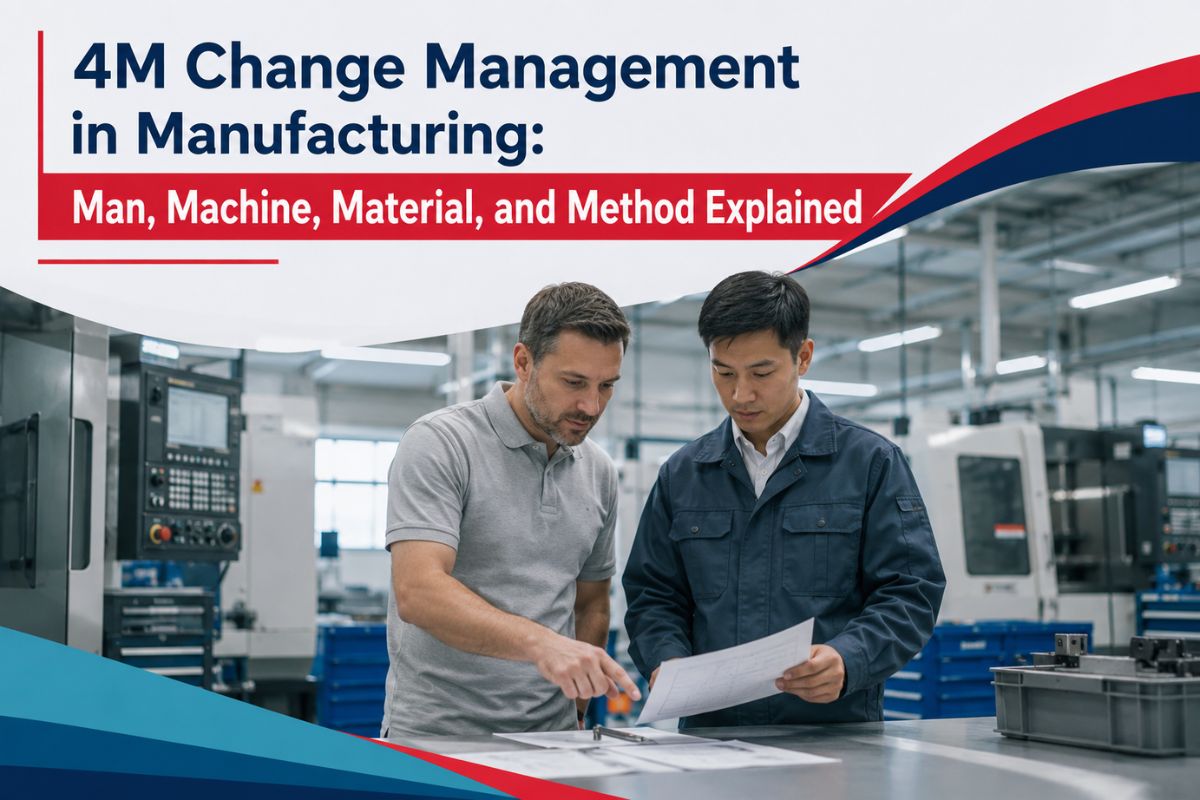
4M Change Management in Manufacturing: Man, Machine, Material, and Method Explained
Written by AmrepMexico Supplier Quality Engineering Team, last updated in September 2026
4M change management is the systematic process of identifying, evaluating, approving, and documenting changes to Man, Machine, Material, or Method before they affect production. It helps prevent quality issues caused by unnoticed changes, such as a new operator, substitute material, swapped tool, or altered setting.
For overseas buyers, 4M change management is a strong indicator of supplier quality maturity. Suppliers that document changes and require approval before implementation are better positioned to prevent quality risks.
This guide covers the four 4M categories, planned and unplanned changes, applicable standards, the step-by-step control process, and common mistakes that allow changes to go undetected.
What Is 4M Change Management?
4M change management is a quality control discipline built around one core idea: any change to the inputs of a manufacturing process, the people running it, the equipment used, the materials consumed, or the method followed, carries a risk of affecting the output, even when the change seems minor. Rather than allowing changes to happen informally, a 4M system requires that every change be identified, assessed for risk, approved by the appropriate authority, and validated before full production resumes.
The term comes from a classic root cause analysis framework (the same four categories, sometimes extended to 5M or 6M with Measurement and Environment, appear in fishbone or Ishikawa diagrams used during defect investigations). 4M change management applies that same logic proactively: instead of asking "what changed?" after a defect is found, it asks "what's about to change?" before it happens.
Why Does 4M Change Management Matter So Much in Overseas Sourcing?
When a factory is thousands of miles from a buyer's engineering team, small changes happen constantly and mostly go unreported. An operator calls in sick and is replaced by someone less experienced. A supplier substitutes a material grade because the usual vendor is out of stock. A worn tool gets swapped for a similar one that isn't quite identical. None of these changes are necessarily malicious, but none of them are harmless either, and without a formal 4M system, they happen invisibly.
The risk compounds because these changes are exactly the kind that don't show up in a standard final inspection unless the defect they cause is dimensional or visual. A subtle material substitution might pass every visual check and still fail in the field months later. A 4M system catches the change itself, not just its eventual symptom.
Is 4M Change Management a Required Standard?
Yes, for automotive and many other regulated supply chains. IATF 16949:2016, Clause 8.5.6 ("Control of Changes") requires organizations to control planned changes and review the consequences of unintended changes, taking action to mitigate any adverse effects. ISO 9001:2015, Clause 8.5.6 contains a closely related requirement for controlling changes for production or service provision.
Many automotive OEMs and Tier 1 suppliers layer their own specific 4M change notification requirements on top of these baseline standards, often requiring written customer approval before certain changes can be implemented at all. Outside automotive, 4M discipline isn't always a certification requirement, but it remains one of the most effective practices any manufacturer can adopt, and buyers increasingly ask about it during supplier audits regardless of industry.
What Are the Four Categories of 4M Change?
The 4M framework focuses on four key areas of the manufacturing process where changes can introduce risk: Man, Machine, Material, and Method.
Man (Personnel Changes)
Any change in who is performing a task. This includes:
- A new or substitute operator running a machine or performing an inspection
- A shift change that introduces different skill levels
- An operator returning from extended leave without a refresher
- Staffing changes due to absenteeism, turnover, or peak-season hiring
Why it matters: Skill and experience directly affect process consistency, especially for manual or semi-automated operations. A less experienced operator may run the same machine with different results, even with identical settings.
Example: A factory's most experienced CNC operator is out for two weeks. A newly trained operator runs the same program but hasn't yet developed the same feel for tool wear monitoring, leading to a gradual dimensional drift that isn't caught until a batch fails final inspection.
Machine (Equipment Changes)
Any change involving the equipment, tooling, or measurement instruments used in the process.
- Switching to a backup or alternate machine
- Replacing a worn tool, die, or mold
- Using a different gauge, caliper, or measurement device
- Equipment relocation or a change in maintenance schedule
Why it matters: Even nominally identical machines can have different calibration states, wear patterns, or process capabilities. A backup machine used during a breakdown may not have the same process capability index (Cpk) as the primary line.
Example: A press shop's primary stamping press goes down for repair, and production shifts to a backup press. The backup press is the same model but has a different wear pattern on its dies, producing a subtle flash defect the primary press didn't produce.
Material (Input Changes)
Any change in the raw materials, components, or supplied parts used in production.
- A different material grade, lot, or supplier
- A substitute resin, alloy, or coating
- Raw material from a new mill or batch with different certification
- Component substitutions from an alternate approved vendor
Why it matters: Material behavior under processing (melt flow, hardness, tensile strength) can vary between lots even within the same nominal specification, and unapproved substitutions are one of the most common root causes behind nonconformances.
Example: A supplier substitutes a lower-cost but nominally equivalent plastic resin mid-run without submitting an engineering change request. The surface finish and impact resistance both shift slightly, passing visual inspection but failing a customer's drop test weeks later.
Method (Process Changes)
Any change to the sequence, parameters, or way a process is carried out.
- A modified process parameter (speed, temperature, pressure, cycle time)
- A revised work instruction or standard operating procedure
- A change in inspection frequency or sampling plan
- A new or altered process step, including automation changes
Why it matters: Process parameters are usually validated together as a set during initial qualification (such as PPAP). Changing even one variable can shift the process outside its validated capability without an obvious visual sign.
Example: A supplier increases oven temperature slightly to speed up a curing cycle and improve throughput, without formally revalidating the change. The faster cycle subtly under-cures a portion of each batch, a defect that isn't visible until the product is stressed in the field.
Planned vs. Unplanned 4M Changes
4M changes can occur in different ways, and each type requires an appropriate response based on its nature and potential impact.
| Change Type | Definition | Example | Typical Response |
|---|---|---|---|
| Planned | A deliberate, scheduled change made with lead time | Approved supplier switching to a new certified material batch | Formal risk assessment, customer notification if required, validation before full production |
| Unplanned | An unexpected change forced by a breakdown, absence, or shortage | A machine breaks down mid-shift and production shifts to a backup | Immediate containment action (increased inspection, first-article check), followed by retroactive documentation and review |
Unplanned changes are riskier precisely because there's no time to evaluate them in advance. A mature 4M system defines containment actions for unplanned changes in advance, so the shop floor has a clear default response (such as 100% visual inspection or recording the first several parts) rather than improvising in the moment.
How Does 4M Change Management Connect to PPAP?
The Production Part Approval Process (PPAP) formally validates that a supplier's process, as it existed at the time of approval, is capable of consistently producing conforming parts. That approval is tied to a specific set of conditions: a specific machine, a specific material source, a specific method, and a defined workforce competency level. A 4M change, by definition, alters one of those approved conditions.
This is why many customer-specific requirements tie 4M change notification directly to PPAP resubmission triggers. A significant material change, a new manufacturing location, or a major process parameter shift often requires a new or partial PPAP submission before the change can be implemented in full production. It is not just an internal sign-off.
Treating 4M change management and PPAP as connected systems, rather than separate paperwork exercises, is what keeps a supplier's original process validation meaningful over time. Otherwise, it can become outdated the first time something on the floor changes.
How Does a 4M Change Management Process Work, Step by Step?
A 4M change management process follows a structured sequence that helps identify, assess, approve, and validate changes before they affect production.
- Identify the change. Any proposed or occurring change to Man, Machine, Material, or Method is logged, whether planned or discovered after the fact.
- Classify the change. Determine whether it's planned or unplanned, and assess its potential severity using the same logic as a risk analysis: how likely is it to affect the product, and how serious would the consequence be?
- Evaluate and approve. For planned changes, a designated authority, often quality engineering, reviews the change before it's implemented. High-risk changes may require customer notification and written approval before proceeding.
- Validate the change. Before full production resumes, run a first-article inspection, a small validation batch, or a process capability study to confirm the change hasn't shifted quality outside acceptable limits.
- Update documentation. Revise the relevant control plan, work instruction, PFMEA, or process flow diagram to reflect the new approved state.
- Communicate the change. Ensure everyone affected, operators, quality inspectors, and where required, the customer, knows the change occurred and what to watch for.
- Monitor after implementation. Increased inspection frequency for a defined period after a 4M change helps catch any delayed effects the initial validation might have missed.
What Does a 4M Change Log Typically Include?
A usable 4M change record should answer the same core questions regardless of category:
| Field | Purpose |
|---|---|
| Change category | Man, Machine, Material, or Method |
| Description of the change | What specifically changed, in measurable terms where possible |
| Reason for the change | Why the change was made or needed |
| Planned or unplanned | Determines the response pathway |
| Risk assessment | Potential impact on product quality or safety |
| Approval | Who reviewed and approved the change, and when |
| Validation method and result | How the change was confirmed not to affect quality |
| Customer notification (if applicable) | Whether and when the customer was informed |
| Effective date | When the change actually took effect on the floor |
What Mistakes Weaken 4M Change Management the Most?
Small gaps in the 4M process can create significant quality risks if changes are not properly controlled.
- Treating minor changes as too small to log. A "small" material substitution or a brief operator swap is exactly the kind of change most likely to slip through without documentation, and exactly the kind most likely to cause an undetected defect.
- No defined approval authority. If it's unclear who has to sign off on a 4M change, operators and supervisors will often make the call themselves at the moment, without a documented risk assessment.
- Validating the change but not monitoring afterward. A first-article check confirms the change is acceptable at that moment. It doesn't guarantee the change remains stable over an entire production run.
- No containment plan for unplanned changes. Without a predefined default response (increased inspection, first-piece checks), unplanned changes get handled inconsistently, and sometimes not at all.
- Disconnected from the control plan. A 4M change that isn't reflected in the updated control plan or work instruction means the next person auditing the process is working from outdated information.
How Does Third-Party Inspection Support 4M Change Control?
Buyers sourcing from Mexican suppliers rarely have visibility into 4M changes as they happen. An inspector physically present in the factory during production is far more likely to notice an unfamiliar operator, a substitute machine, or a process parameter that doesn't match the approved control plan. This means an undocumented 4M change gets caught before it becomes a nonconformance rather than after. This kind of on-the-ground verification pairs naturally with a supplier's own factory audit process. Any deviations that are caught typically feed into the same 8D problem-solving methodology used to resolve other nonconformances.
Frequently Asked Questions
Is 4M change management only required in the automotive industry?
It's formally required under IATF 16949 for automotive suppliers, but the underlying discipline benefits any manufacturer. Buyers in electronics, medical devices, and general industrial manufacturing increasingly expect suppliers to demonstrate some form of 4M control even without a certification mandate.
What's the difference between 4M and 5M or 6M?
4M covers Man, Machine, Material, and Method. Some organizations extend this to 5M by adding Measurement (the inspection or gauging system itself), or 6M by also adding Environment (temperature, humidity, cleanliness). The extended versions are more common in root cause analysis than in change management, but either framework can be applied to change control.
Does every 4M change require customer notification?
No. Customer-specific requirements vary, but generally only changes assessed as higher risk, such as a new supplier for a critical material or a significant process parameter shift, require formal customer notification and approval before implementation. Lower-risk changes are typically managed internally with documentation.
How is a 4M change different from a nonconformance?
A 4M change is a planned or unplanned shift in a process input. A nonconformance is a product, material, or process that fails to meet a specified requirement. A poorly managed 4M change is one of the most common root causes behind a nonconformance, but the two are tracked differently: one is a change record, the other is a defect record.
Can a supplier be IATF 16949 certified without a functioning 4M system?
In practice, no. Control of changes is a specific clause requirement (8.5.6), and auditors typically check for a documented 4M change log, an approval process, and evidence of validation as part of a certification or surveillance audit.
Prevent Supplier Quality Escapes with AMREP Mexico
Uncontrolled 4M changes are one of the most common, and most preventable, causes of supplier quality escapes. AMREP Mexico's Quality Inspections and Supplier Quality Engineering teams work directly inside supplier facilities across Tijuana, Monterrey, Reynosa, Guadalajara, Querétaro, Mexico City, and other Mexican manufacturing hubs. They catch undocumented Man, Machine, Material, or Method changes during production before those changes reach a shipment. Contact AMREP Mexico to build a 4M change control process your suppliers actually follow.